
Industrial beam saws to maximise your production
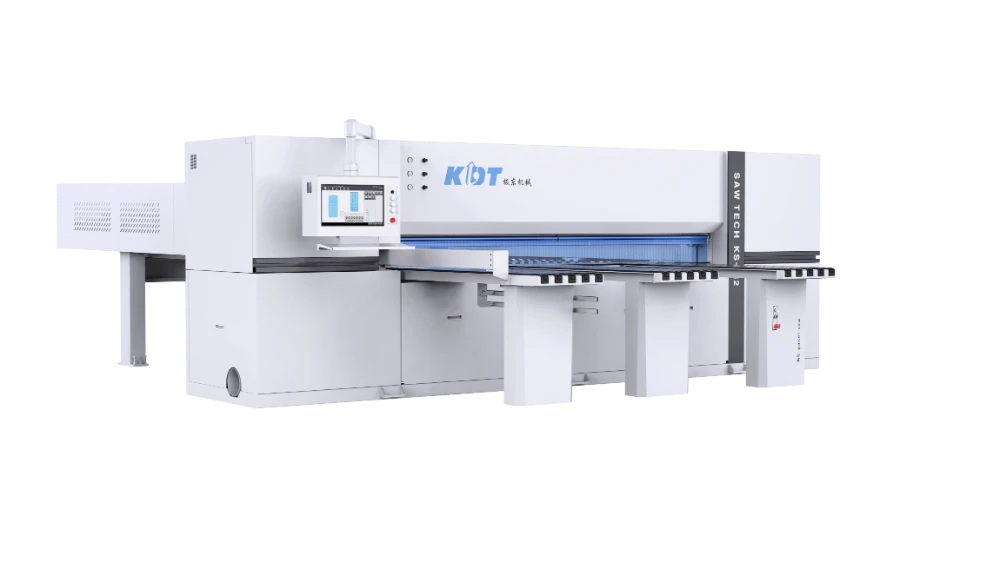
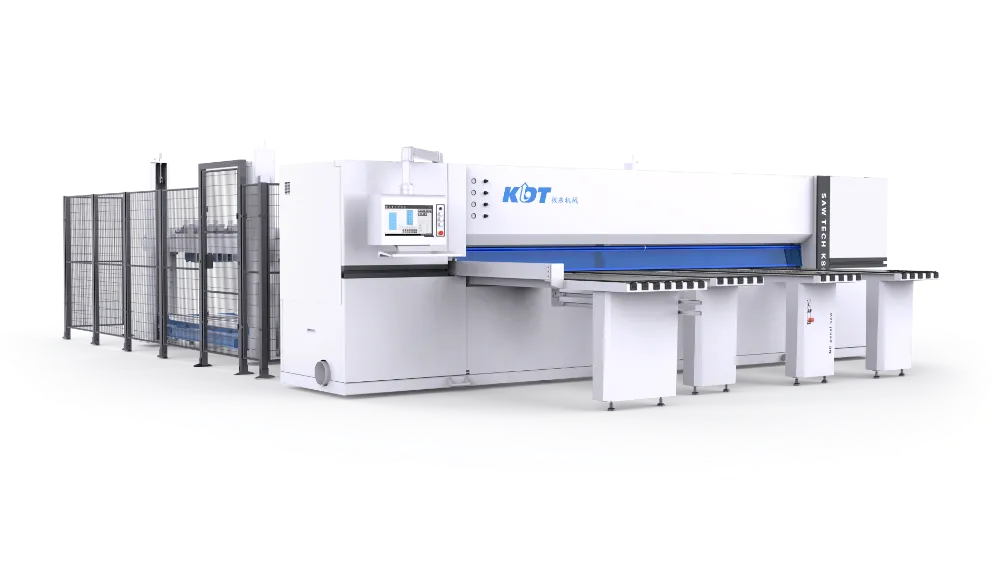
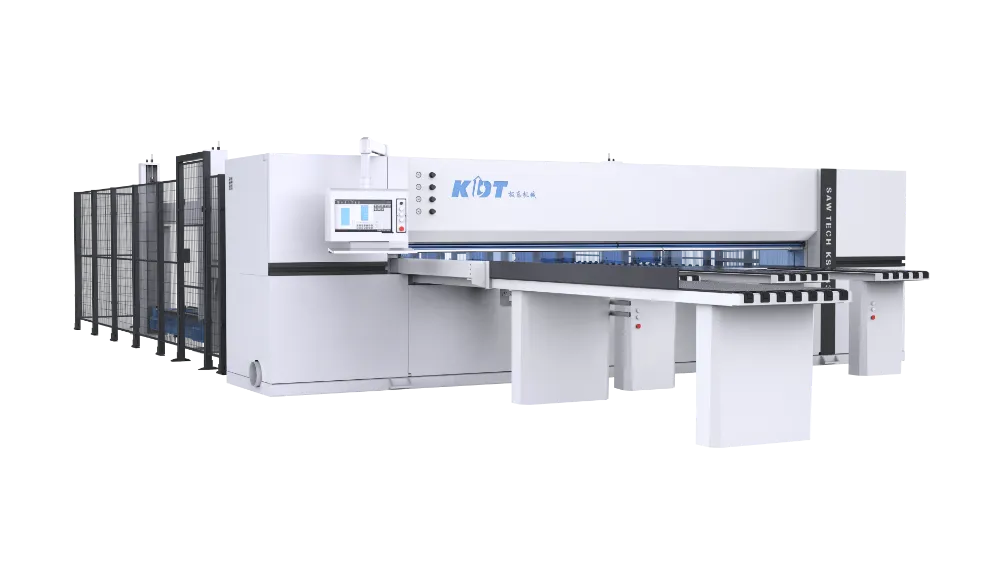
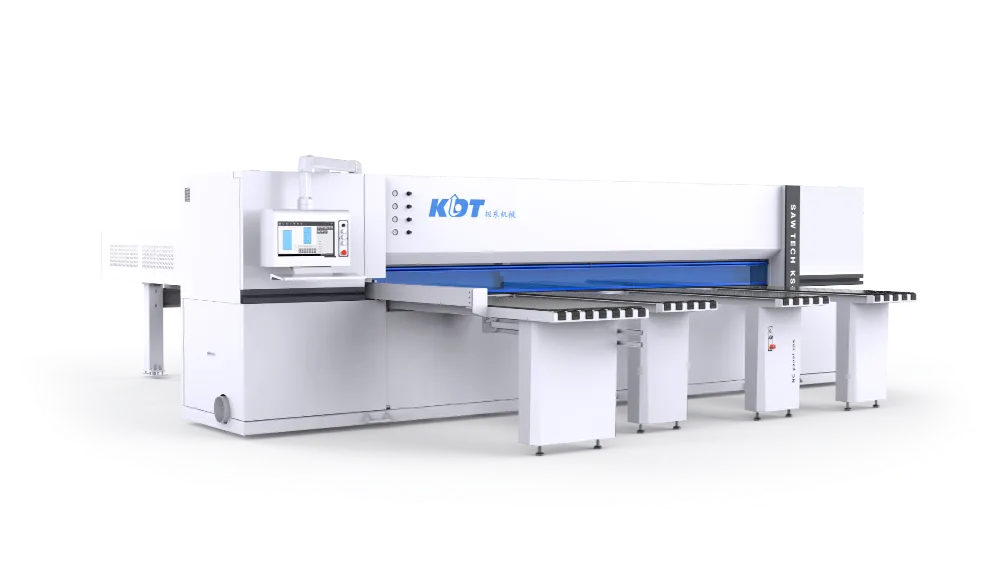
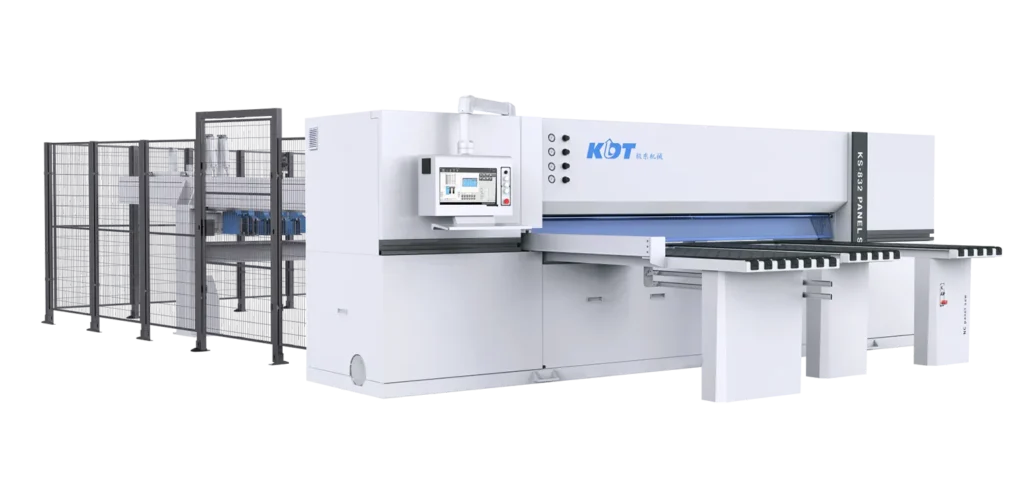
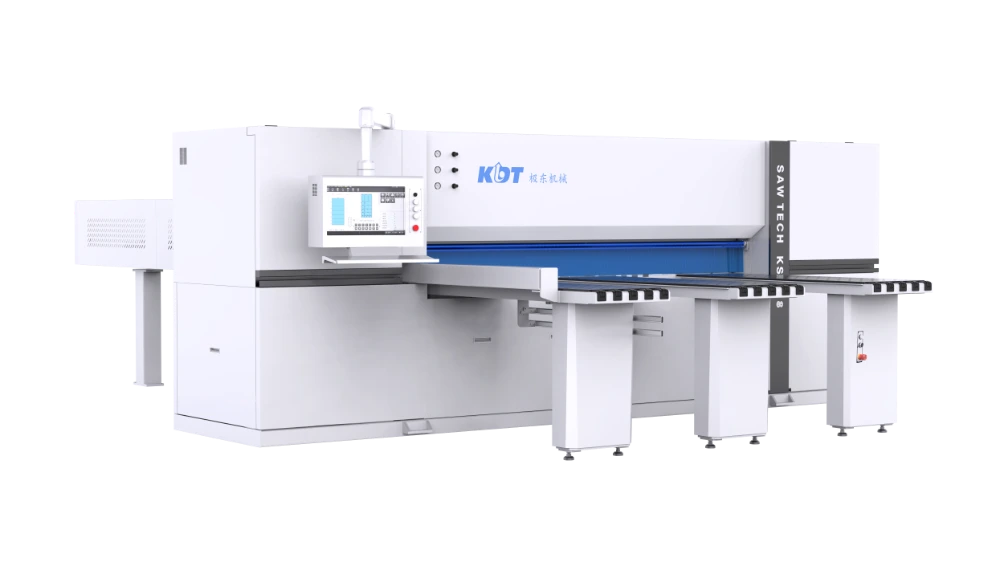
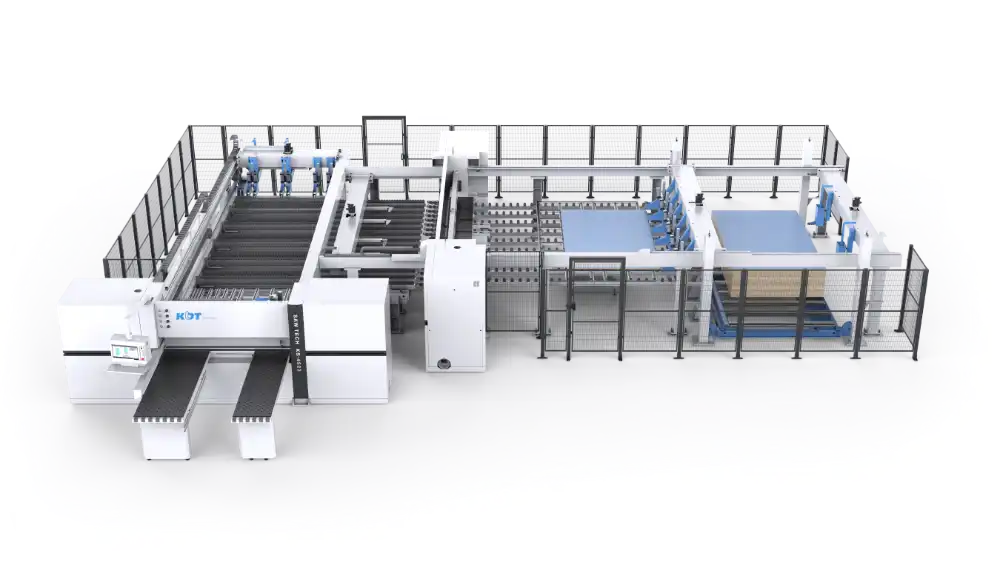
We offer seven different models to cover from medium-scale production to fully automated high-volume lines.
Each model addresses a specific production profile; below we show you the complete range so you can identify which one fits your process:
- KS-832D — Front-loading beam saw designed for medium production requiring reliability and speed without a high-end investment. View product
- KS-843L — Rear-loading model with greater panel capacity, ideal for furniture manufacturers with long and varied runs. View product
- KS-843HL — Rear-loading version with greater cutting height, aimed at thick board stacks and high-performance production. View product
- KS-843D — Front-loading with extended features; combines versatility and speed for growing workshops. View product
- KS-832L — Rear-loading in compact format: takes up less space without sacrificing precision or cycle capacity. View product
- KS-828D — Entry-level professional front-loading beam saw, perfect for companies making the leap from more manual processes. View product
- KS-4522HLS — High-performance angular beam saw, the most advanced option in our range for high-volume production lines with angled cuts. View product
If you have doubts about which model best suits your workload, we recommend reading our guide how to choose a beam saw before contacting us.
KDT beam saw range: models for every need
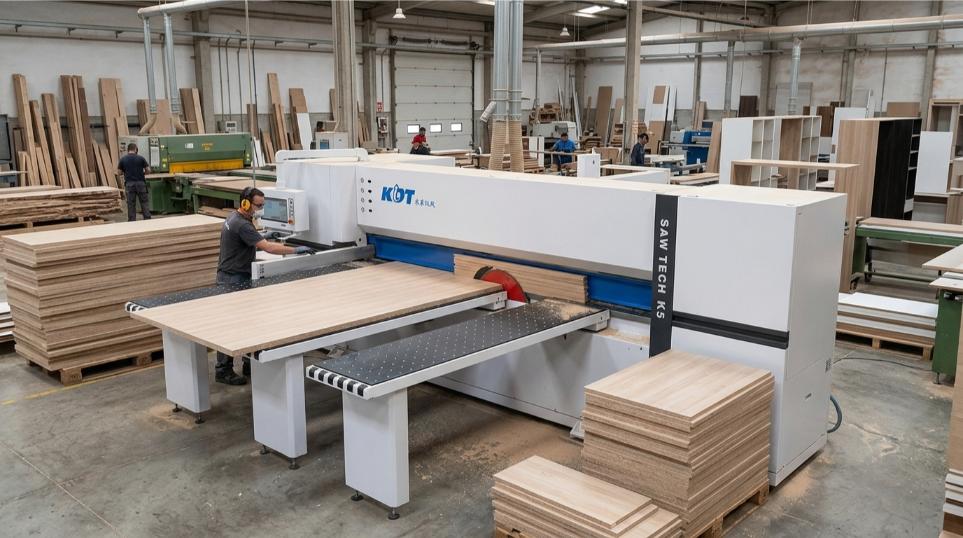
If you run a furniture factory, an industrial joinery or a timber construction company, the beam saw is the machine that sets the pace for your entire production line.
An imprecise cut, a slow cycle or a machine that stops due to breakdown doesn't just generate waste: it costs you customers. At KDT Ibérica we offer a range of panel saws designed so that every cut counts, from the first piece to the last shift.
What is a panel saw and how does it work?
A beam saw is a cutting machine designed to divide large-format panels into pieces of the exact dimensions required by each project. Unlike a conventional saw, it works on the stationary panel whilst the saw carriage advances along a precision guide, which guarantees straight, clean and reproducible cuts in every cycle.
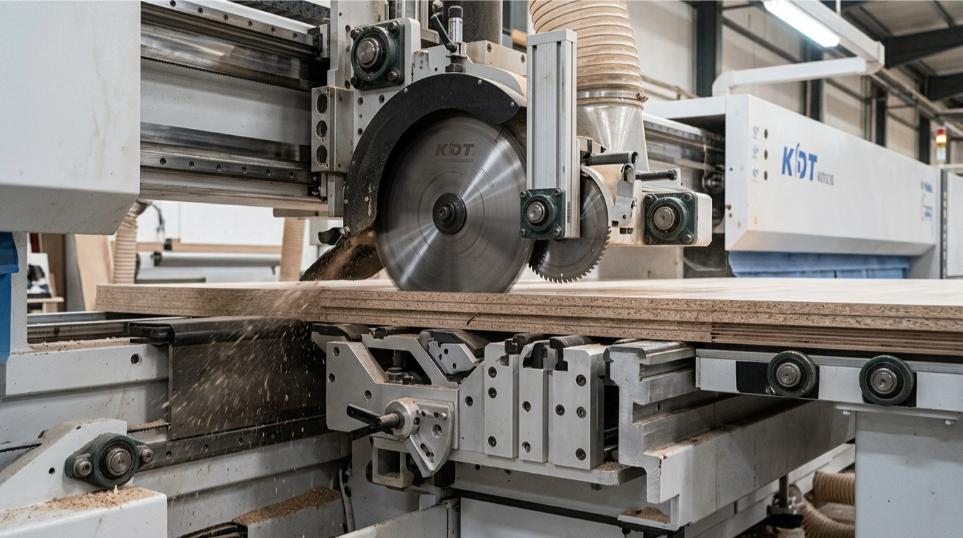
The operating principle is simple: the operator (or the automatic system) positions the panel on the work table, sets the cutting dimensions on the control panel and the main saw, together with the scoring saw or pre-cut saw, executes the cut in a single pass. The pre-cut prevents chipping on the underside of the panel, something especially important with melamine or veneered materials.
Materials compatible with KDT beam saws:
- Particleboard (chipboard) and melamine
- MDF and lacquered MDF
- Plywood and OSB
- Solid wood (in thicknesses adapted to the model)
- Technical plastics and low-density composite materials
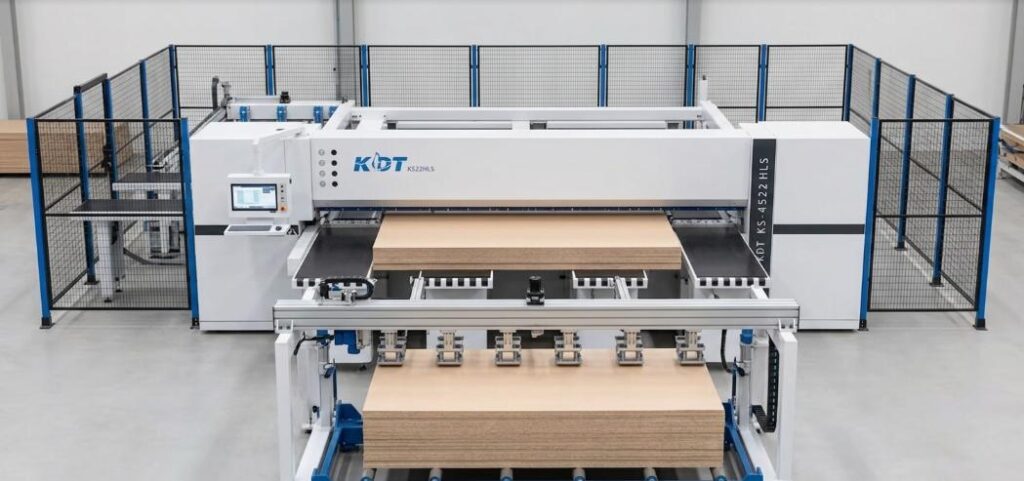
Types of beam saws: which one suits your process?
Not all beam saws are the same, and choosing the wrong one can meanpaying for features you don't use or, conversely, slowing down your production with an inadequate machine. These are the key criteria to guide your decision:
Beyond the level of automation, the choice between a standard model and one with greater capacity depends on the maximum panel size you process and the stack height you need to cut in each cycle. The KS-843HL range, for example, extends the cutting height capacity for those working with stacks of several panels at once, thereby reducing the number of cycles per batch.
In the joinery and timber construction industry, precision and efficiency are fundamental to guaranteeing high-quality products. Our beam saws are designed to meet the different needs of your business offering advanced solutions for cutting panels and other materials, ensuring optimum performance in every production process.
KDT beam saws are ideal for companies engaged in timber construction, window and door manufacturing, and furniture production. Their ability to perform crosscuts and sections of different types of wood (chipboard, MDF, melamine…) makes them versatile tools for various projects.
Beam saw in the joinery and timber construction industry
Semi-automatic (front loading)
Suitable for medium production runs or workshops where the operator is involved in loading the panel. They are more accessible in price and easier to integrate into confined spaces. The KS-828D, KS-832D and KS-843D models fall into this category. They are a good option if your daily production does not exceed 80–100 panels and you value the flexibility to change dimensions frequently.
Automatic (rear and angular loading)
For high-volume production, the rear-loading beam saws (KS-832L, KS-843L, KS-843HL) and the angular KS-4522HLS work with CNC pusher systems that eliminate manual intervention in each cycle. The result is greater speed, lower risk of error and natural integration into continuous production lines. They are the right choice if your factory operates in one or more shifts with long runs.
Innovation in wood splitting machines
KDT beam saws incorporate cutting-edge technologyto guarantee precise and efficient cuts at high speeds. These machines are equipped with automated systems that facilitate material handling and storage, reducing set-up time and increasing productivity.
Furthermore, their design allows easy integration into existing production lines, optimising workflow in joinery workshops and furniture factories.
Key features of the KDT switch-disconnectors
KDT Ibérica beam saws offer solutions for all professionals seeking to optimise their production processes in terms of both time and materials, reduce costs and at the same time achieve more comfortable and safer working conditions for the operator. These machines are designed to integrate into automated manufacturing lines, guaranteeing continuous and efficient workflow.
Our beam saws stand out for a wide range of features that make them essential tools for the industry:
- High speed and precision: Powerful servomotors on the high-speed panel cutting saw carriage ensure clean and precise cuts with every operation.
- Advanced automation: integrated automation systems enable cutting scheduling and process optimisation, reducing errors and improving efficiency.
- Return and handling systems: incorporate return systems that facilitate part handling and optimise workflow, especially on high-volume production lines.
- Intuitive software: the control software is easy to use and allows integration with other digital systems, facilitating production management and monitoring, as well as a panel labelling option for identification of processed workpieces.
Technical features that make the difference in performance and precision
When you compare models from different manufacturers, the catalogue figures look similar. What really differentiates one machine from another in day-to-day operation are the engineering details that affect real production performance:
- Carriage feed speed: higher cutting speed reduces cycle time, but must be accompanied by a rigid structure that does not transmit vibrations to the workpiece. In KDT models, the welded steel frame absorbs vibrations and maintains cutting tolerance even in continuous cycles.
- CNC pusher fence precision: numerically controlled fence positioning eliminates human error in dimension adjustment. In long runs, this translates into zero out-of-tolerance workpieces and real material savings.
- Prescoring systems: the scoring saw prior to the main cut prevents chipping on melamine-faced boards, which is decisive when the visible finish is part of the final product.
- Software cutting optimisation: the management software calculates the most efficient cutting plan for each batch, minimising offcuts and reducing panel consumption. In a factory with medium production volume, this can represent savings of between 3% and 8% in material.
- Active safety systems: light curtains, calibrated emergency stop and cutting area guards that comply with CE regulations and protect the operator without slowing down the work pace.
A beam saw is more powerful when it forms part of an integrated line. The automation systems for beam saws allow you to add automatic loading platforms, roller tables, output and sorting systems, and even connect the beam saw with the factory management software to receive cutting orders directly.
When does it make sense to invest in automation?
- When the panel loading and unloading time represents more than 30% of the total cycle.
- When you work in two or more shifts and the operator becomes the bottleneck.
- When you need piece-by-piece traceability within your production line.
Automation systems for beam saws: elevate your production level
At KDT Ibérica we analyse your current line and propose the level of automation that pays for itself within a reasonable timeframe for your volume. We don't sell automation for the sake of it: we tell you when it makes sense and when it doesn't.
At KDT Ibérica we not only offer you high-quality machinery, but we also work to provide you with a comprehensive technical assistance service. We understand that production continuity is vital for our clients, which is why we have a team of specialised professionals who provide technical support, preventive maintenance and rapid solutions to any issue. Our commitment is to ensure that the machines operate at maximum performance at all times.
Adaptability to production needs
Each company has specific requirements in its production line. That's why each beam saw is designed to adapt to diverse needs, from small-scale production to high-volume manufacturing lines. The versatility of our machines allows their integration into different industrial environments, always guaranteeing high performance and cutting quality.
Technical assistance and after-sales service
Why choose KDT Ibérica as your beam saw supplier
The difference with KDT isn't just in the product: it's in what happens after the sale.
Physical showrooms in Spain, Portugal and Morocco. You can see the machines in operation before deciding. Not catalogues or videos: real production, with the technician alongside answering your questions.
Specialist after-sales service with coverage across all three countries. Our technical assistance service operates with our own technicians, not subcontracted. That means shorter response times and in-depth knowledge of every machine we install.
Customised adaptation of each project. If your production line has particular requirements, we study them together. From the beam saw configuration to its integration with other equipment, the process is designed for your factory, not the other way round.
Proven sector experience. We've spent years working with furniture manufacturers, industrial joinery workshops and timber construction companies in the Iberian and North African markets. We understand the processes, timescales and real demands of the sector.
If you're also considering other cutting machines for your workshop, check our range of industrial sliding table saws: they're the natural complement to beam saws in many production lines.
Request your personalised quote
Tell us what you produce, what volume you handle and what space you have available. With that information, our technical team will propose the beam saw that best fits your production line, without forcing a configuration you don't need or leaving you short on capacity.
Frequently asked questions about beam saws
How much does an industrial beam saw cost?
The price of a beam saw varies depending on the level of automation, cutting capacity and accessories included. Entry-level professional models start at accessible figures for medium-sized workshops, whilst fully automated lines represent a larger investment with a return proportional to production volume. We recommend requesting a personalised quote to obtain a price tailored to your exact configuration.
What is the difference between a beam saw and a sliding table saw?
The beam saw is designed to cut large-format panels in series, with the panel on the table and the cutting carriage in motion. The sliding table saw works with the workpiece moving over the guide and is more suitable for already dimensioned pieces requiring fine squaring. They're complementary machines: many factories use both at different stages of the process.
Can an already installed beam saw be automated?
It depends on the model and age of the machine. In many cases it is possible to add automation peripherals (loading platforms, roller tables, labelling systems) without replacing the entire machine. Our technical team can assess your current equipment and tell you what options you have.
What maintenance does a panel beam saw require?
Basic maintenance includes periodic inspection and replacement of the saw blades, cleaning of the guide and feed systems, lubrication of moving parts and calibration of the CNC fence. With a preventive maintenance plan, the service life of an industrial beam saw easily exceeds ten years under normal production conditions.
What materials can I cut besides wood and board?
KDT beam saws are compatible with MDF, melamine, chipboard, plywood, OSB and some low-density technical plastics. For special or composite materials, it is advisable to consult our technical team to verify the most suitable saw configuration.
 Spanish
 Portuguese
 English