
Nesting CNC machining centres: CNC panel machining with maximum efficiency
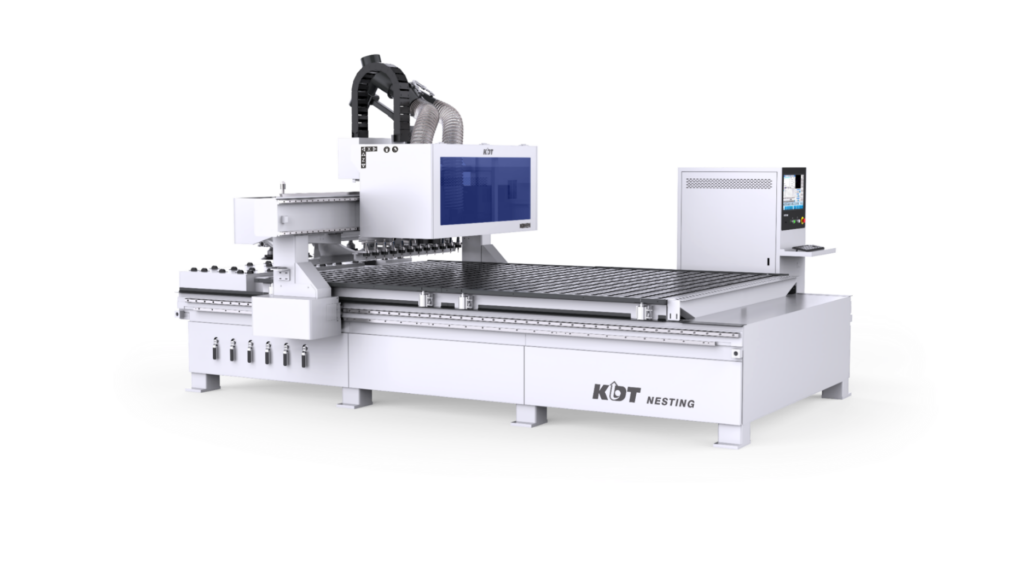

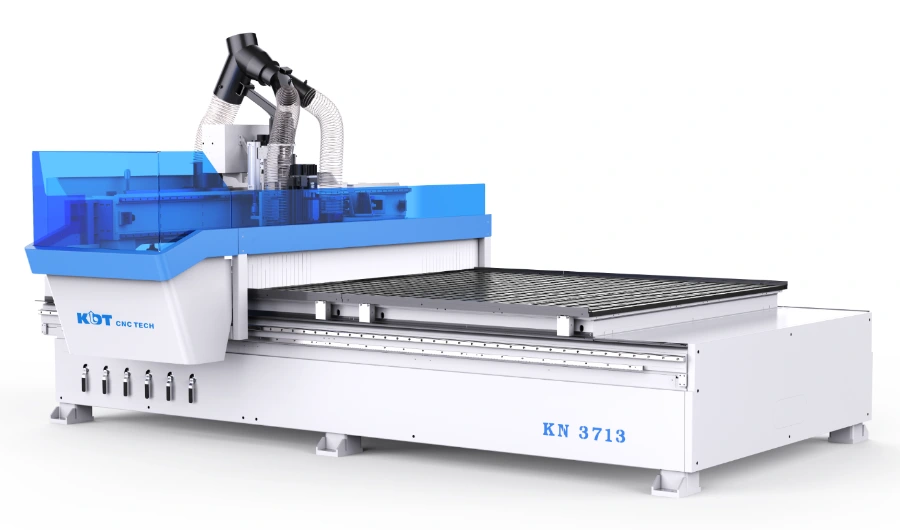



The term nesting refers to the process of cut optimisation whereby the control software groups and distributes the workpieces to be machined across the panel surface in the most efficient way possible. The result is the least material waste with the fewest tool passes.
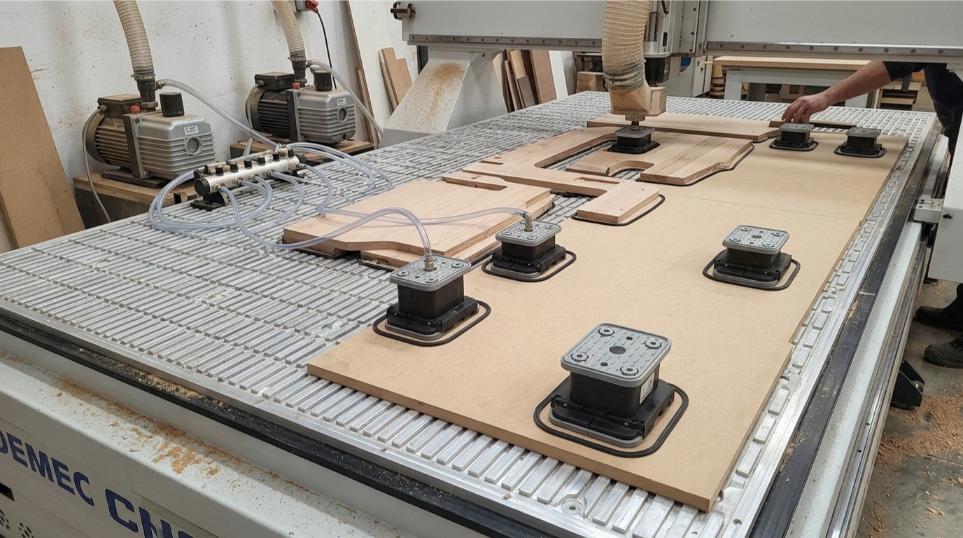
Unlike machining centres with aluminium bars, which clamp workpieces using grippers, nesting centres fix the entire panel on a vacuum table. The suction system holds the panel without the need for perimeter clamping, which allows machining from the edge and working with workpieces of any shape or size without changing the configuration.
The usual workflow is as follows:
- The workpieces are designed in the CAD/CAM software (compatible with the most widespread formats in the furniture sector).
- The nesting software calculates the optimum distribution on the panel and generates the CNC programme.
- The operator loads the panel onto the vacuum table.
- The machine executes the programme: perimeter cutting, boring, routing and any additional operations in a single load.
- The workpieces are ready for the next stage of the production line.
This process drastically reduces changeover time between batches and enables the manufacture of small lots with the same efficiency as large production runs, something particularly valuable in bespoke furniture production or custom kitchens.
If you want to explore the process in depth, you can consult our complete guide on what the nesting process is and how it works in CNC joinery.
What is a nesting machining centre and how does it work?
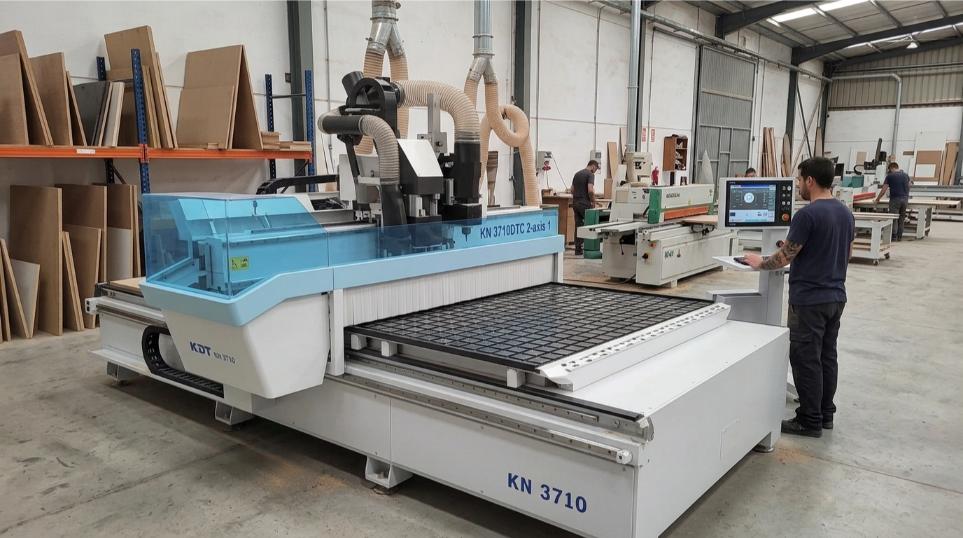
KDT nesting CNC machining centre models
At KDT Ibérica we have a complete range of nesting centres designed to suit different production realities: from joinery workshops taking the step towards automation to industrial plants with automatic loading and unloading lines. These are the available models:
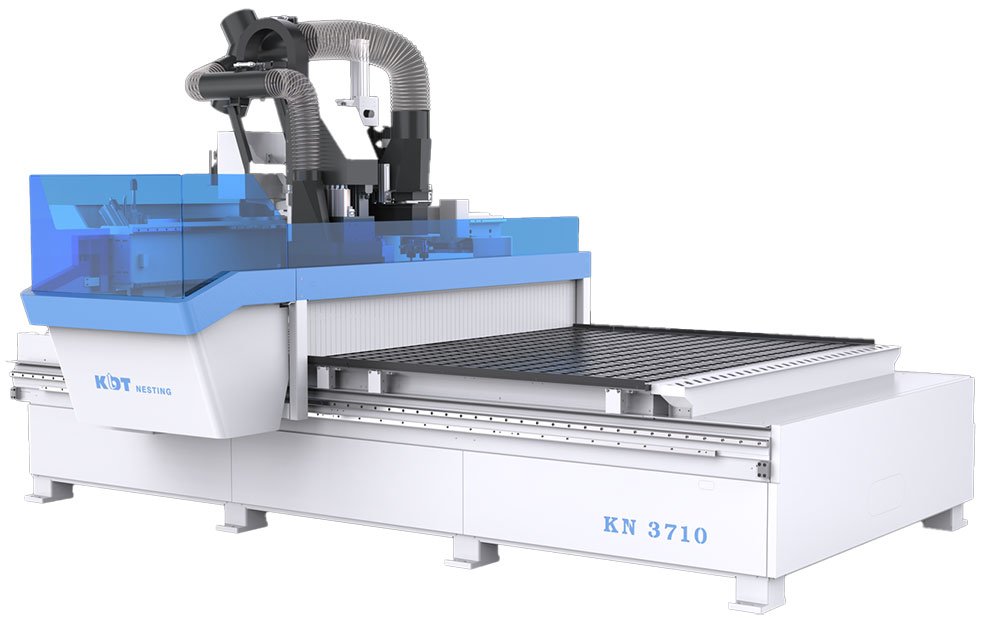
KN-3710DP machining centre
The The KN-3710DP is our reference model within the nesting range: a vacuum table CNC machining centre that combines performance, versatility and a competitive entry cost for medium-sized workshops and factories.
Main features:
- Large-format work tables for standard panels of 3700 × 1000 mm (consult exact specifications according to configuration).
- Head with spindles for combined boring and routing.
- High-power vacuum system for secure panel fixing without the need for additional tooling.
- Compatible with industry nesting software (IWood, PolyBoard and standard DXF/DWG formats).
This model is a good choice for bedroom, living room or bathroom furniture manufacturers that need to machine parts with varied geometry in short or medium batches without investing in complete automation systems. If you want to see all the product details, access the technical data sheet from the list below.
KN-2710DL machining centre
The KN-2710DL is designed for environments where cycle speed is critical. Its design optimises head travel time and tool management, resulting in a higher number of panels machined per shift.
Technical profile:
- Working area adapted to panel formats of 2700 × 1000 mm.
- Equipped with tool magazine for automatic tool change without interrupting the programme.
- Particularly suited for production of kitchen carcases, wardrobes and bathroom furniture with repetitive components.
- Compact design that reduces the floor footprint compared to longer models.
The ideal customer for the KN-2710DL is the industrial joinery or kitchen manufacturer working with medium to high production runs, where every minute of cycle time has a direct impact on production margin.
At KDT Ibérica we have several models of nesting CNC machining centres to offer you adapted to different production volumes and technical requirements. They all share the same principle: maximising panel utilisation, reducing set-up time and automating the cutting and machining process so that your team produces more with less effort.
KN-3713DPC Machining Centre with C-Axis
The KN-3713DPC with C-Axis is the most advanced model in the range and the one that opens up the most machining possibilities. The C-axis enables continuous spindle rotation, which allows angular milling, engraving and curved path operations that are not possible on standard 3-axis nesting centres.
What changes with the C-Axis?
- Ability to machine grooves and curved geometries in a single pass without workpiece repositioning.
- Greater design freedom in products such as decorative doors, profiled kitchen fronts or furniture with organic shapes.
- Reduction of secondary operations in the workshop, because the machine resolves on the nesting centre what previously required an additional operator.
Compared to 3-axis models, the KN-3713DPC guarantees production flexibility that justifies the investment in factories with complex product catalogues or competing in the high added-value segment. Consult the complete technical data sheet to see all available specifications.
Best seller · In stock · Nesting CNC machining centres
KN-3710DP machining centre View product
KN-2710DL machining centre View product
KN-3713DPC C-Axis machining centre View product
Nesting centrepieces
KN-3713D machining centre View product
Nesting centrepieces
KN-3713D machining centre with loading, unloading and labelling machine View product
Nesting centrepieces
KN-3713D machining centre with loading and unloading View product
Nesting centrepieces
KN-3710DPC C-Axis machining centre View product
KN-3710DP CNC with labelling machine and automatic unloading View product
Nesting centrepieces
KN-3710DP machining centre with loading and unloading View product
Materials and workpieces that a nesting centre can machine
One of the great advantages of nesting technology is its compatibility with a wide variety of panel materials. KDT machining centres are designed to work with:
- MDF board (raw, lacquered or melamine-faced): the most common material in the manufacture of kitchen, bathroom and bedroom furniture.
- Chipboard and melamine: for production of functional and economical furniture with high repeatability.
- Laminated solid wood panel: in joinery workshops that combine industrial production with higher quality finishes.
- Composite materials and aluminium panels: depending on the tooling configuration, it is also possible to work with technical panels for the interior design or vehicle body sectors.
As for the parts, the nesting centre does not only cut: in a single load it can perform contouring, hardware drilling, grooves for backs, rebates and any profile routing required by the part. This eliminates intermediate operations and reduces manual handling, with the resulting savings in time and potential manufacturing errors.
The resulting finish depends on the type of tool and the cutting parameters, but under normal working conditions clean edges are obtained that guarantee a surface quality suitable for the subsequent edge banding process without the need for additional sanding.
Advantages of KDT nesting CNC machining centres for your factory
Incorporating a nesting centre into your production line is not just a technological decision: it is a business decision. These are the specific benefits that our customers report most frequently:
Added to this is the reduction of human error: by programming the machining from the software, the dimensions are always the same regardless of the shift or the operator working the machine.
In furniture production, where a tenth of a millimetre can compromise the assembly of a piece of furniture, that consistency has enormous value.
If you are interested in expanding the possibilities of your nesting centre with automatic loading systems or in-line integration, see our section on automation systems for nesting CNC machining centres.
Material and cost optimisation
- Nesting software minimises panel waste, which reduces the raw material cost per manufactured part.
- Possibility of utilising offcuts (remnants) by integrating them into the cutting plan for subsequent batches.
- Lower consumption of tooling and clamping devices compared to aluminium bar systems.
Flexibility and automation
- Batch changeover with no setup time: the CNC programme manages everything from the software.
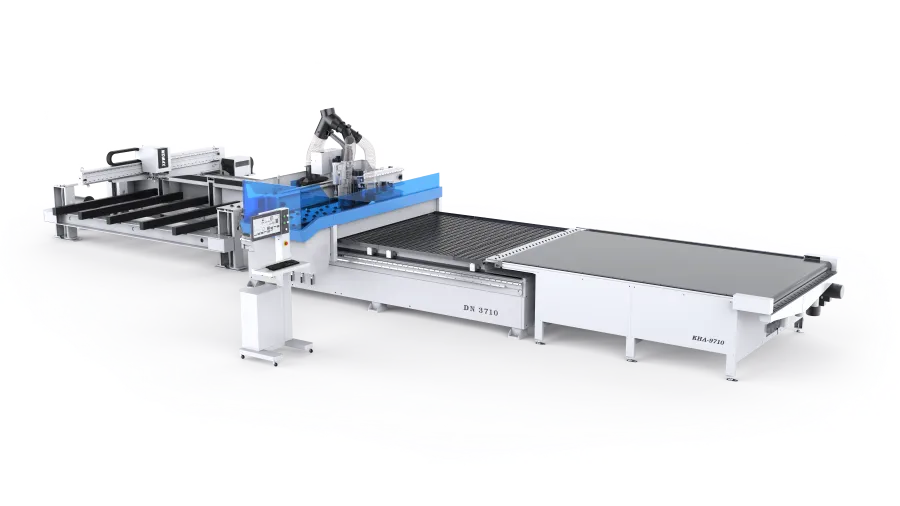
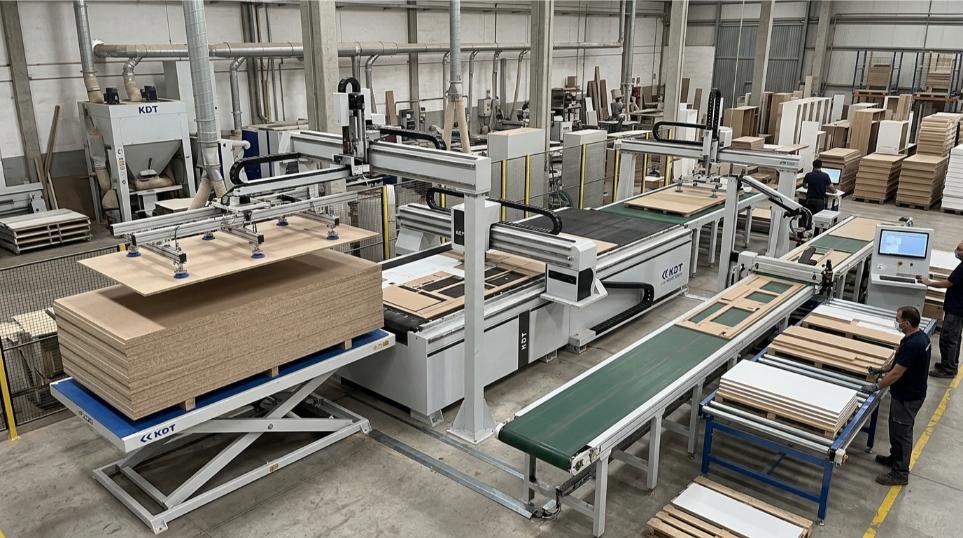
- Automatic loading and unloading options available on several models to reduce operator dependency.
- Integration with automatic labelling machines for workpiece traceability on the shop floor.
What type of company is a nesting centre ideal for?
KDT nesting CNC machining centres suit a specific customer profile. If you identify with any of these situations, it's worth having a conversation:
- Bedroom, living room, bathroom or kitchen furniture manufacturers working with panel boards and needing to machine parts of varied shapes in short or medium runs.
- Industrial joinery workshops looking to move from manual or semi-automatic production to a CNC line without investing in a complete plant.
- Interior or wardrobe door manufacturers needing to combine cutting, boring and profile routing in a single operation.
- Interior design studios with their own workshop producing bespoke furniture and requiring flexibility to work on unique designs with complex geometries.
If you're unsure which model best suits your situation, our guide on how to choose a machining centre for your workshop can help you define the criteria before requesting a quote.
KDT Ibérica: showrooms, customisation and specialist technical service
Buying industrial machinery is not like adding a product to an online shop basket: it requires trust, real technical information and the assurance that support will be there when you need it.
At KDT Ibérica we have spent years supporting furniture manufacturers and industrial joinery workshops in Spain, Portugal and Morocco, and we know that what our customers value most is not just the machine, but what comes afterwards.
These are the pillars of our value proposition:
- Physical showrooms in Spain, Portugal and Morocco: you can see the equipment in operation before making a decision. We don't sell you a machine from a catalogue: we show it to you working with real materials.
- Adaptation to each project: if your production line has specific conditions (available space, integration with existing lines, need for partial automation), our technical team analyses your case and proposes the most suitable configuration.
- Specialised after-sales and technical service: initial training for your operators, remote support and on-site assistance to ensure that the machine produces from day one and continues to do so throughout its entire service life.
- Spare parts and consumables available: we work to ensure that no breakdown leaves you stopped for longer than necessary.
The quality of the equipment is the starting point. After-sales service is what determines the real return on your investment.
If you've got this far, you're clear that you need real information before making a decision. We can help you in three ways:
- Request a personalised quote: fill in the contact form with your company details and your type of production. Our technical-commercial team will respond with a proposal tailored to your situation.
- Visit one of our showrooms: in Spain, Portugal and Morocco you can see the equipment in operation with real material. No slide presentations, no laboratory demos.
- Download the catalogue: if you prefer to review the models at your leisure before speaking to us, request our updated nesting range catalogue.
What we guarantee at KDT Ibérica is not just the delivery of a machine: it's that the machine adapts to your process, your team knows it well from day one and you have support when you need it.
Request your personalised quote
Request a quote or view the KDT nesting centres catalogue
What is the difference between a nesting centre and an aluminium bar centre?
The main difference lies in the workpiece clamping system. In machining centres with aluminium bars, workpieces are clamped individually with grippers or stops on the bars, which allows faces and edges to be machined with greater freedom but requires more set-up time. In nesting centres, the entire panel is fixed on a vacuum table and machined whole before the pieces are separated. Nesting is more efficient for panel production with multiple pieces per load; aluminium bars are better suited for complex machining of individual workpieces or jobs with many operations on all four edges.
How much does a nesting machining centre cost?
The price depends on the model, the worktable, the number of spindles, the tool magazine and the automation options. To give you a figure tailored to your actual configuration, the most straightforward approach is for you to tell us about your case and we will prepare a personalised quote with no obligation.
What software are KDT nesting centres compatible with?
Our machines are compatible with the main CAD/CAM systems in the furniture sector, including IWood, PolyBoard and the standard exchange formats DXF, DWG and MPR. If you already use specific software in your workshop, contact us and we will verify compatibility before any decision.
What maintenance does a nesting centre require?
Preventive maintenance includes periodic inspection of the vacuum system, lubrication of guides and spindles, inspection of cutting tools and cleaning of the chip extraction system. Our After-Sales team provides you with the recommended maintenance schedule for each model and can train your team to carry it out autonomously.
Can a nesting centre be integrated into an existing production line?
Yes. Several of our models have automatic loading and unloading options and integration with labelling machines, which facilitates their incorporation into production lines already in operation. Tell us how your plant is organised and we will study the best way to integrate it.
 Spanish
 Portuguese
 English