
In any joinery workshop or furniture factory, sanding is one of those stages that marks the difference between "correct" work and a truly professional finish.
And this is where the question arises: how to choose an industrial sanding machine that truly fits your production and which are the best sanding machines for joinery according to your needs.
It's not just a matter of power or price. Choosing the wrong sanding machine can translate into downtime, rework, material waste and irregular finishes. On the other hand, getting the right machine allows you to improve workflow, increase quality and reduce errors on every workpiece.
In this guide we're going to look at, from a practical workshop perspective, what you should consider when buying your sanding machine, what the different types of industrial sanding machines are and how to know which is the best option for your case.
Why having an industrial sanding machine is essential for your joinery workshop
An industrial sanding machine is a machine designed to work wood surfaces (and other materials) in a continuous, precise manner with a homogeneous finish level. They are designed for:
- Repetitive work
- Series production
- Large volumes of material
- High-quality finishes
In a professional environment, sanding is not just about "smoothing" a surface. It's about preparing the workpiece for lacquering, gluing or assembly. And that's where precision and control make the difference.
In the day-to-day running of a workshop, an industrial sanding machine allows you to:
- Prepare surfaces for finishing: remove imperfections after CNC machining or cutting on a beam saw.
- Standardise pieces in series production: especially in furniture factories where each piece must be identical.
- Reduce manual work: what previously required several hours with hand tools can now be completed in minutes.
- Work with different materials: although the main use is wood, it also allows sanding of melamine boards, MDF or veneers.

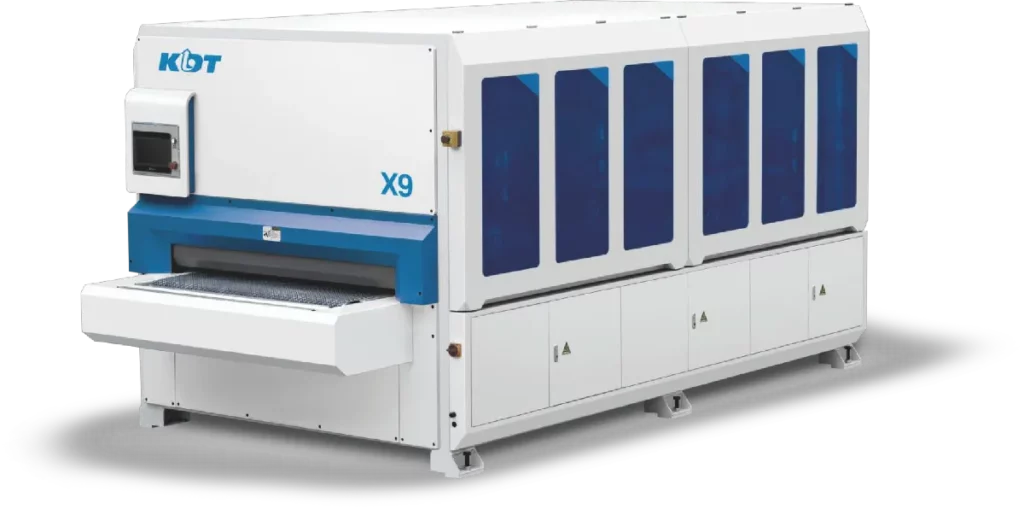
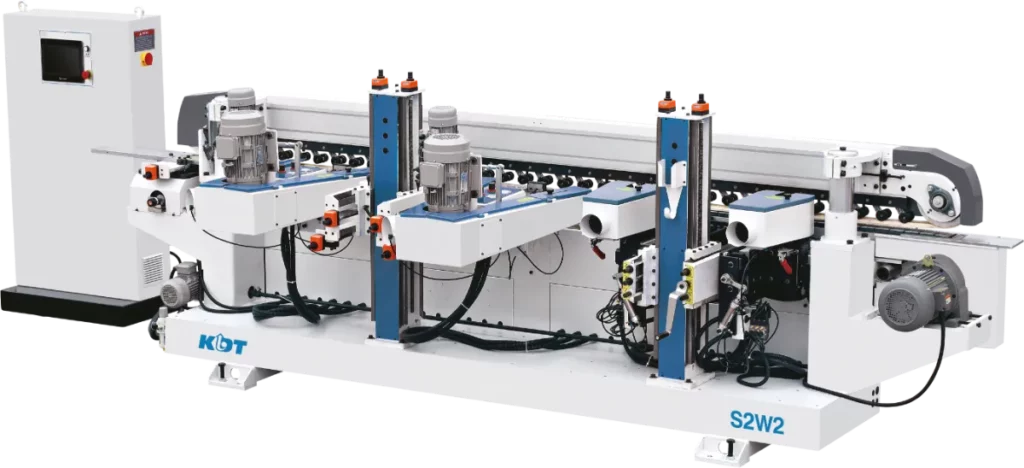
Different types of industrial sanding machines (and when to use each one)
Choosing between the different sanding machine models depends on the type of joinery work you carry out. Below we tell you what the most popular options are:
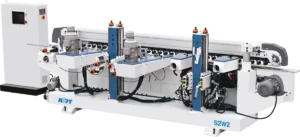
Sanding and grooving machine
Combines sanding with the creation of grooves or specific machining operations, widely used in door manufacturing.
Allows working in a single pass, saving time and ensuring precision on repetitive workpieces. Ideal for workshops looking to automate specific processes and avoid subsequent manual operations.
Brush sanding machine
Uses abrasive brushes (instead of belts) that adapt better to irregular or textured surfaces.
Useful for:
- Doors with mouldings
- Textured panels
- Structured surfaces
Thanks to its multiple brush units with different grits, it allows performing from intermediate sanding to finishing without needing to change abrasives, improving production efficiency
Calibrating sander
One of the most important professional tools in industrial joinery. You can perform two functions, calibrate (equalise thickness) y sand the surface.
Works with wide belts and systems such as rollers or platens, which allows:
- Obtaining perfectly flat surfaces
- Controlling material removal with precision
- Achieving uniform finishes on large production runs
It is the foundation in any furniture or panel production line.
Edge and corner sanding machines
Designed to work areas where other machines cannot reach: edges and corners. They allow:
- Sanding straight or curved edges
- Improving the finish on small workpieces
- Avoiding manual touch-ups
They are key in workshops that work with fine detail, as they ensure a homogeneous finish even in difficult areas.
What to consider when buying an industrial sanding machine
This is where you really decide whether you're making a good investment or not. Analyse the following:
1. Type of work you carry out
A craft workshop is not the same as a furniture factory. Ask yourself:
- Do I work on unique pieces or series production?
- What daily volume do I handle?
- What type of finish do I need?
2. Power and capacity
A machine with high power allows you to work faster, but it must also be adapted to the material.
- For MDF or panels → medium-high power
- For solid wood → greater demand
3. Precision and control
A good control system allows you to adjust:
- Sanding pressure
- Speed
- Thickness removed
This is key to avoiding errors and material waste.
4. Dust extraction system
Often overlooked, but it is essential. A good extraction system:
- Improves visibility
- Prevents defects in the finish
- Protects the machinery
- Improves workshop health
5. Ease of use and maintenance
An industrial machine must be robust, but also practical.
- Quick belt changes
- Simple adjustments
- Maintenance access
6. Integration with other machines
If you already work with CNC or automated lines, the sanding machine must integrate into the workflow. This enables:
- Automation
- Reduced downtime
- Greater efficiency
A good choice improves your entire process
Choosing an industrial sanding machine well is a decision that directly impacts your day-to-day operations: fewer errors, higher production and better finishes.
If you're at that point where you need to improve your sanding process and are looking for the best industrial wood sanding machines, it's worth analysing the options carefully.
Visit our industrial sanding machines section on our website to see the available solutions and request no-obligation advice right now by completing our form
Frequently asked questions about choosing an industrial sanding machine
Which sanding machine to choose for the best result?
There is no single answer to "which is the best sanding machine for wood".
The best option always depends on the Type of production, Material and Level of finish required
When to move from manual to industrial sanding machine?
When work volume increases, there are quality issues or you need to standardise results.
Does an industrial sanding machine really improve production?
Yes. It allows you to work faster, with fewer errors and a much more uniform finish.

 Spanish
 Portuguese
 English