
Industrial wood sanding machines: KDT professional range

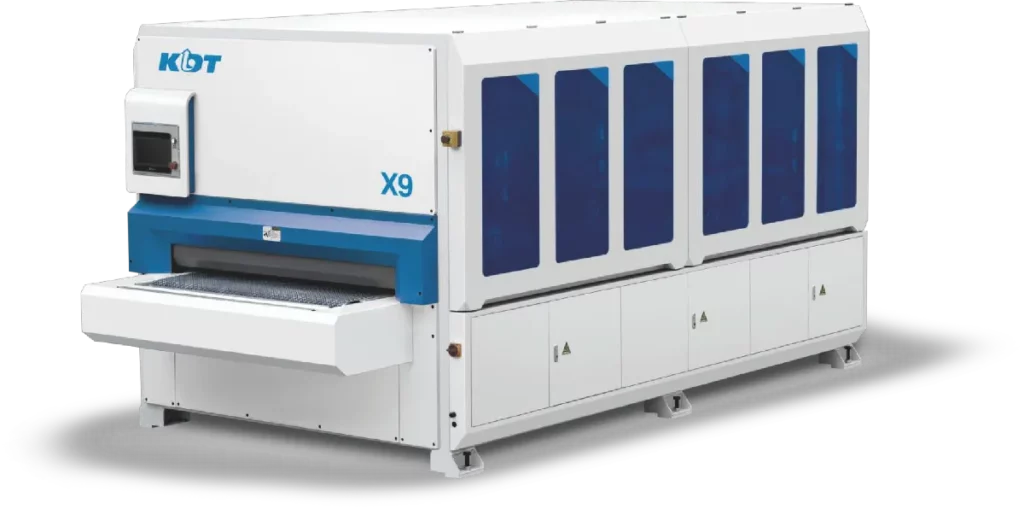
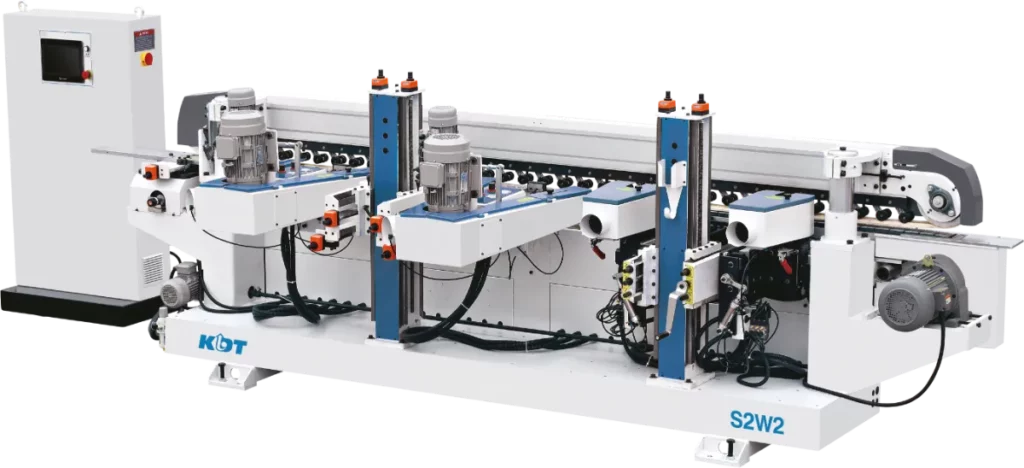
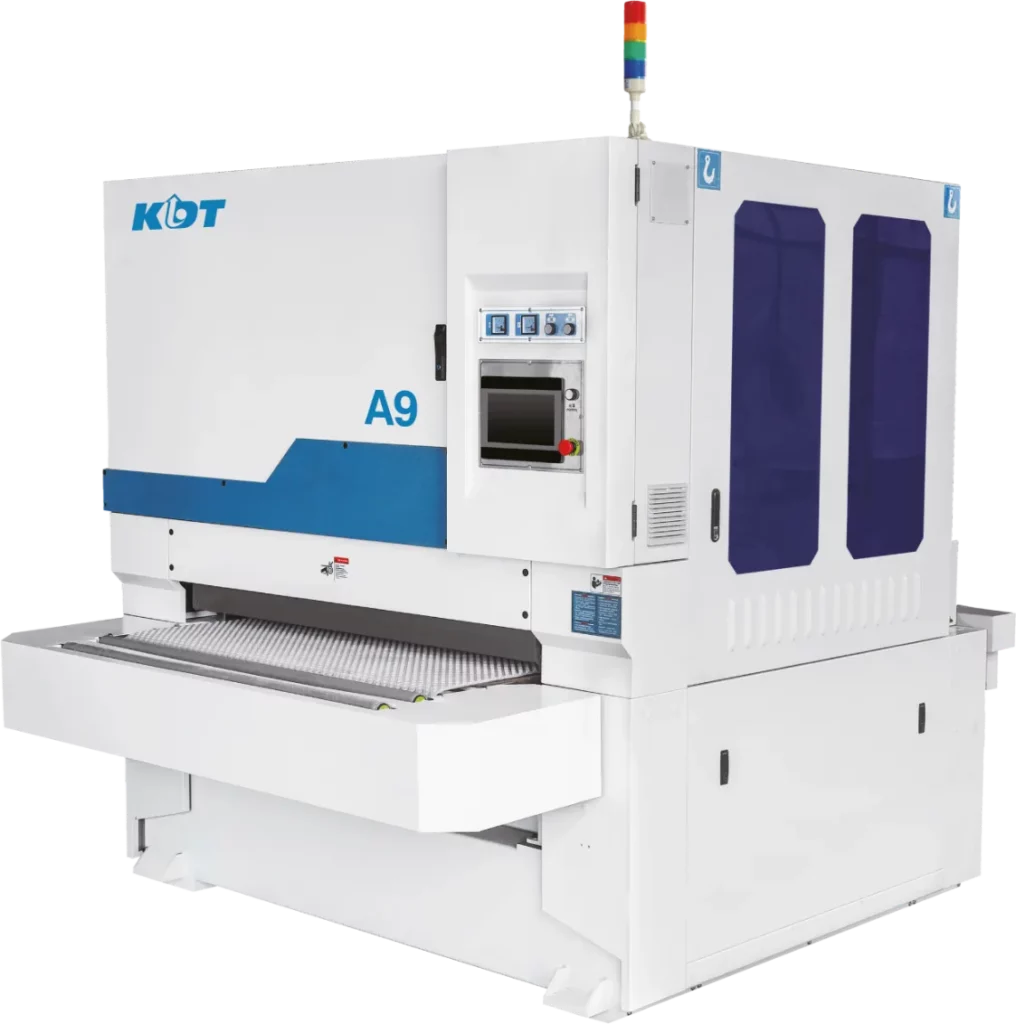
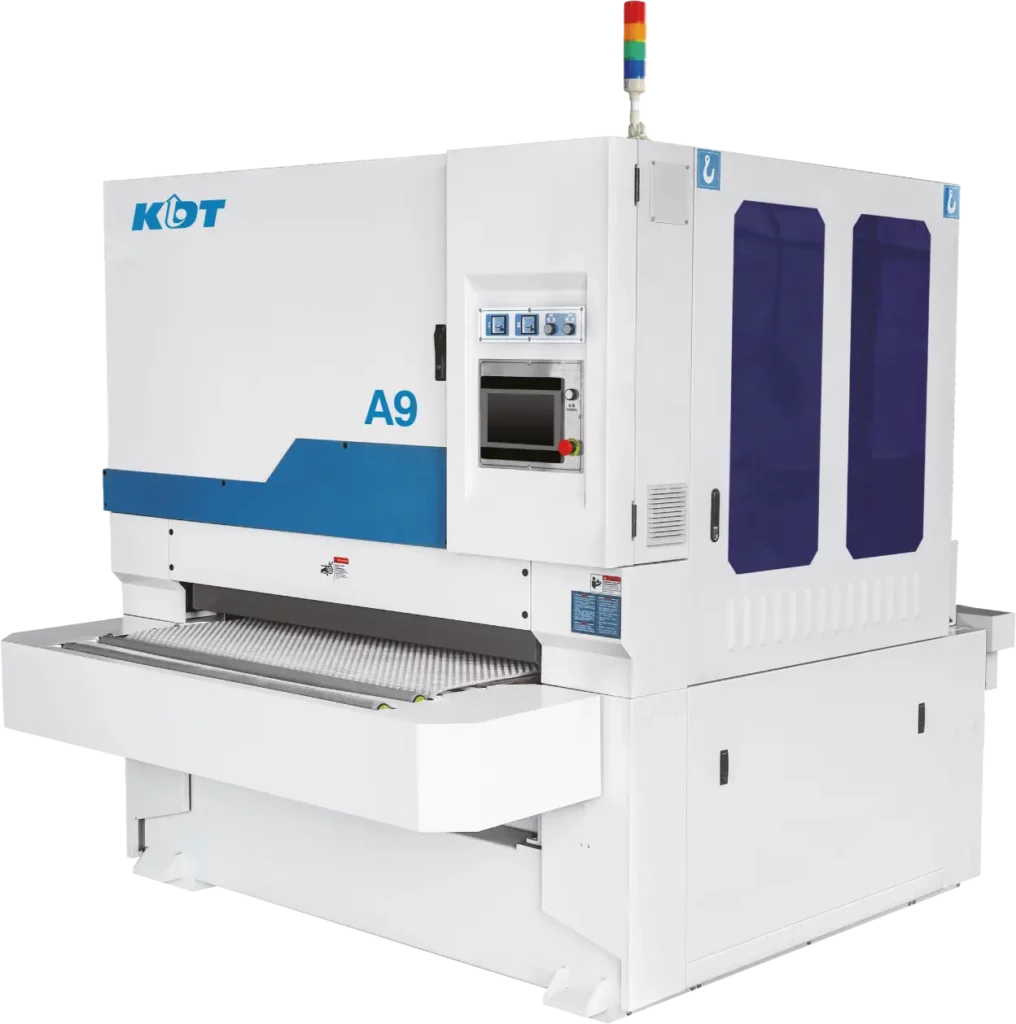
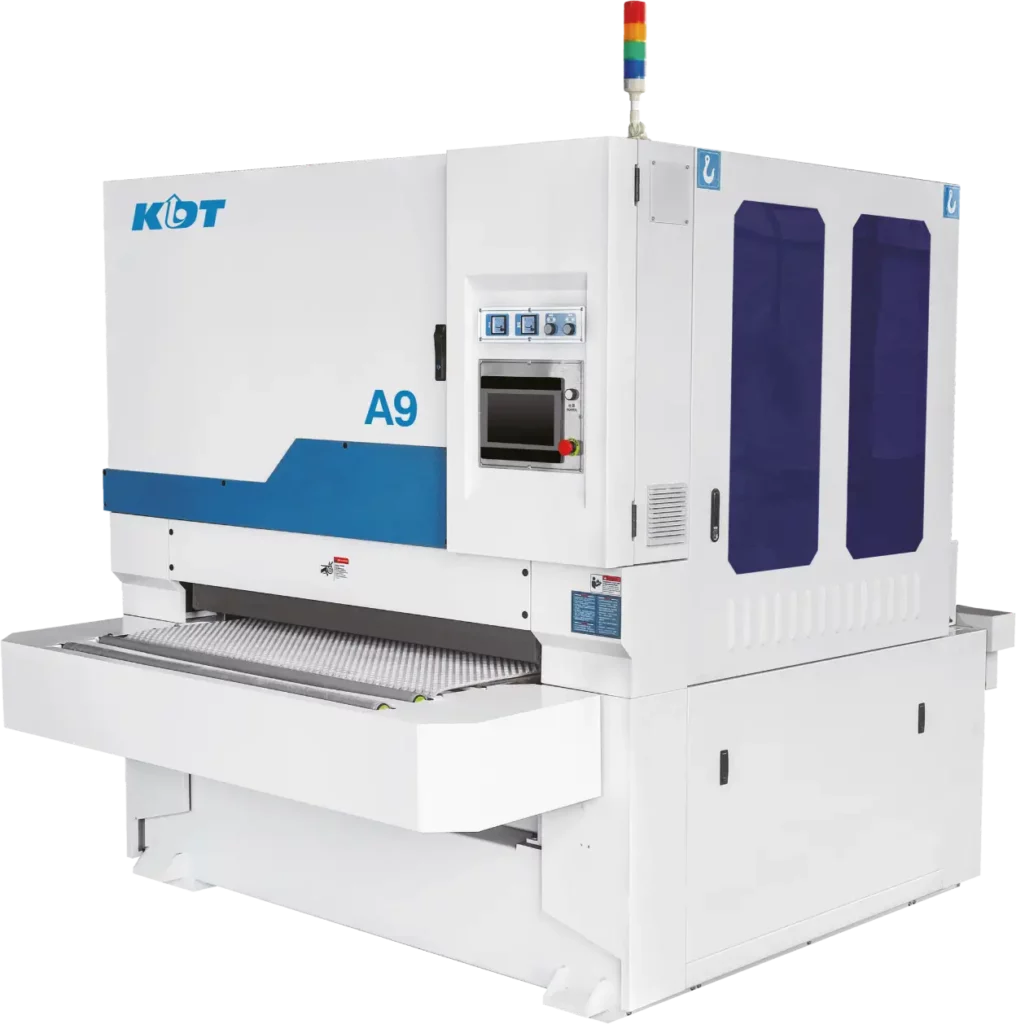
The industrial wood sanding machine market is broader than it appears. There is no single machine that solves all processes: each type of sanding machine is designed for a specific production stage. Understanding the differences enables you to choose correctly and avoid bottlenecks in the line.
The main types we work with at KDT are:
- Small wood wide belt sander: for levelling and calibrating the thickness of panels and flat workpieces.
- Sectional pad sander: similar to the wide belt sander, but with the capacity to work pieces of different thicknesses in the same pass.
- Edge sanding machine: for finishing the edge on edge-banded pieces.
- Brush sanding machine: for surfaces with relief, textures or pronounced grain.
- Profile sanding machine: for profiles, frames and complex geometries.
Below we explain each one with technical criteria.
What types of industrial sanding machine exist for working wood?
Wide belt sander for wood
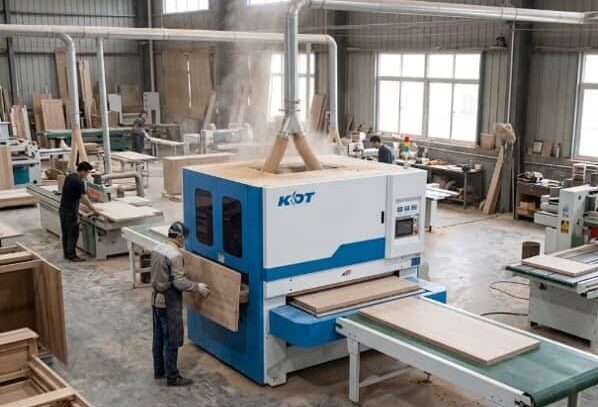
The wide belt sander is the reference machine in any panel and furniture production line. Its main function is to eliminate thickness differences between pieces and achieve a flat and uniform surface before finishing. It works by means of one or more abrasive rollers that act on the piece whilst it advances through the feed table.
In series production, it provides two clear advantages: total homogeneity between pieces y adjustable feed speed to adapt to different materials and grit sizes. When you have to sand hundreds of panels per day, the wide belt sander pays for itself quickly.
Within this category, a double roller sanding machine allows two sanding operations to be carried out in a single pass. The first roller can handle calibrating or stock removal, whilst the second performs finer sanding to achieve the desired finish. This configuration is particularly interesting in production lines seeking to reduce working times and maintain uniform quality between pieces.
Regarding electrical supply, the single-phase wide belt sander is the usual option in small workshops or with limited electrical installation, whilst three-phase models offer greater power and are most common in factories.
If you are looking for a wide belt sander for wood 1300, we have several models with this working width.
Wood edge sanding machine
The edge sanding machine works the lateral profile of the workpiece once it has passed through the edge banding machine. Its purpose is to finish and refine the applied edge, eliminate irregularities and leave a clean edge ready for final finishing.
In integrated lines, the edge sanding machines for wood are positioned immediately after the edgebander to close the cycle without intermediate handling. It is a key tool when the edge finish level is a requirement of the final product.
At KDT Ibérica we bring together everything that a professional factory or workshop needs to sand wood with precision and without wasting time.
Our range covers from the wide belt sander for large format wood to the edge sanding machine for live edge finishes, including brush sanding machines, moulding sanders and sectional pad sanders.
If you are looking for the best professional wood sanding machine, here you will find the solution adapted to your production volume and your specific process.
Brush sanding machine and moulding sanding machine
These are two different machines, although they are sometimes confused. The brush sanding machine works on surfaces that are not completely flat: wood with pronounced grain, textured boards or workpieces with slight relief. The abrasive brushes adapt to the shape of the workpiece and distribute the sanding uniformly without removing excessive material.
The moulding sanding machine, on the other hand, is designed for profiles with complex geometry: door frames, shaped strips, decorative pieces. Its heads follow the contour of the profile, something that no rigid roller can do with the same quality.
If your production includes profiled or relief elements, combining both machines gives you total coverage.
Sectional pad sander
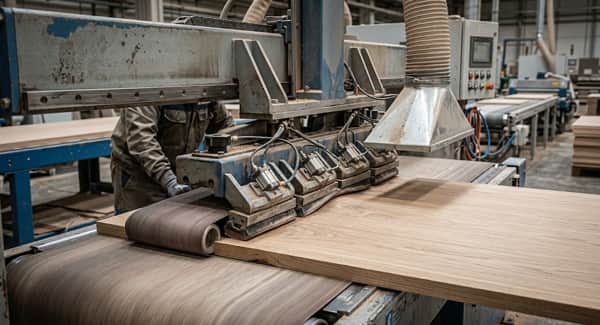
This is the machine that makes the difference in lines where workpieces of different thicknesses coexist. Unlike a standard wide belt sander, the sectional pad sanding machine has the pad divided into independent sections that exert pressure differentially on the workpiece. This allows processing of assembled doors, panels with relief or assemblies of parts with varying heights without the lower areas being left unsanded or the higher areas suffering excessive sanding.
It is the reference solution in door factories, bespoke furniture manufacturers and production lines with high part variety. Consult our range of sectional pad sanders to view the available models.
How to choose the best industrial sanding machine for your process?
Before deciding which machine you need, it is advisable to answer four specific questions:
It is also important to distinguish between industrial machinery and tools intended for manual work. An orbital sander, for example, may be useful for touch-ups, small surfaces or occasional finishing work, but does not offer the continuous production capacity of an industrial sanding machine.
If the objective is to process hundreds of parts per shift, the choice must be made with productivity in mind and not solely based on the type of finish.
If you have doubts about which is the ideal configuration for your factory, in our article how to choose an industrial wood sanding machine you will find a detailed guide with real application examples.
At KDT Ibérica, we understand that having a high-quality tool is essential to achieve impeccable results in every job. Here, we present our selection of industrial wood sanding machines, designed to simplify the process, guarantee a perfect finish and meet all your needs in the sanding industry.
It integrates seamlessly into environments where precision, safety and efficiency are key. With a robust design and optimised function, the industrial wood sanding machine is an indispensable companion for those seeking to obtain exceptional results in surface preparation and finishing.
High precision industrial sander
Key questions before purchasing
- What is the maximum width of your parts? (Defines the minimum working width of the machine.)
- What production volume do you have per shift? (This determines the power and feed speed required.)
- Are all your workpieces the same thickness or do they vary? (Key to choosing between a standard sander and a sectional platen.)
- Is your electrical installation single-phase or three-phase? (This limits or expands the range of available models.)
Technical criteria to compare
- Belt width: from 650 mm for small workshops up to 1300 mm or more for production lines.
- Motor power: the harder the material and the higher the feed speed, the greater the power required.
- Number of heads: more heads allow calibrating and finishing operations to be combined in a single pass.
- Integrated extraction system: reduces dust in the workshop and extends abrasive life.
Key features of the industrial wood sanding machine
The sanding machine stands out for various aspects that make it indispensable in the industry. Among its most relevant features are:
- Precision and quality: each industrial wood sanding machine has been developed to achieve uniform sanding, allowing high quality results to be obtained with every pass.
- Versatility: Whether for sanding edges, tables or large surfaces, the industrial wood sander is suitable for various types of work.
- Power and safety: Equipped with high-performance electric motors, these sanders ensure efficient sanding without compromising the safety of professionals during the process.
- Sanding belts with hoovers: with a system of suction inlets to collect the dust and improve the sanding work and guarantee the best finishes.
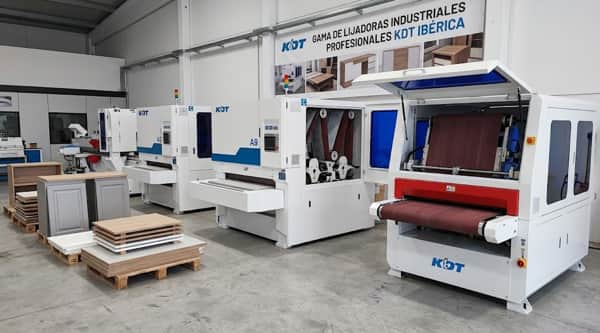
In our online shop you will find a wide variety of industrial sanding machines for your work. Below is a list of the most notable:
- Calibrating sander sectional platen line sander for flat surfaces A9-1300HH with super finisher
- Brush sanding machine PX9-V2H2R2Q2C1
- Sanding and grooving machine for door jambs T4I
- Edge sanding machine S2W2
- Calibrating sander for flat surfaces A3-1300RR
Types of sanders at KDT Ibérica
What sets KDT Ibérica apart from other professional wood sanding machine suppliers is not just the catalogue. Our proposition combines a documented in-house range with a genuine advisory service that begins long before any order is signed.
We have showrooms in Spain, Portugal and Morocco where you can see the machines running with real workpieces, not laboratory demonstrations. This allows you to validate the finish, feed speed and extraction system performance before making any decision.
Furthermore, our technical team and specialist After-Sales Service supports the customer throughout the machine's entire service life: from commissioning through to preventive maintenance and incident resolution. In an industrial production environment, downtime has a direct cost; that is why after-sales service is not an add-on, but part of the product.
KDT industrial sanding machines: technology adapted to your factory
If you already know which type of sander you need, request a quote and information now. If you still have doubts about which machine best fits your process, tell us about your case and our technical team will advise you without obligation.
You can visit one of our showrooms in Spain, Portugal or Morocco to see the machines in operation, get in touch directly to receive the complete catalogue adapted to your sector.
Request your personalised quote for woodworking machinery
Frequently asked questions about industrial wood sanding tools
What is the difference between a wide belt sander and a belt sander?
Belt sander is a more generic term that describes any machine that uses a continuous abrasive belt.
A wide belt sander is a specific type of belt sander optimised for levelling panel thickness with high precision. All wide belt sanders are belt sanders, but not all belt sanders are wide belt sanders.
Can I use a single-phase wide belt sander in a small workshop?
Yes. Single-phase models are designed precisely for workshops with standard electrical installation.
They are ideal when production volume does not require the power of a three-phase motor. If you expand your installation in the future, you can upgrade to a three-phase model without changing the entire line.
What maintenance does an industrial wood sander require?
Basic maintenance includes periodic inspection of the belt or abrasive roller, cleaning of the extraction system and checking the tension and centring of the belt. A preventive maintenance plan every six months extends the machine's service life and prevents unplanned downtime.
Is an integrated extraction system necessary?
In an industrial environment, yes. Having a professional sanding machine with extraction is key. Sanding dust not only affects the quality of the finish, but also operator safety and abrasive life.
A giraffe sander with extraction or a wall sander with extraction, for example, can be a practical solution for manual work on walls, ceilings or large surfaces, but does not replace the extraction system required in an industrial production line.
 Spanish
 Portuguese
 English