
Door machining: industrial machinery for every operation
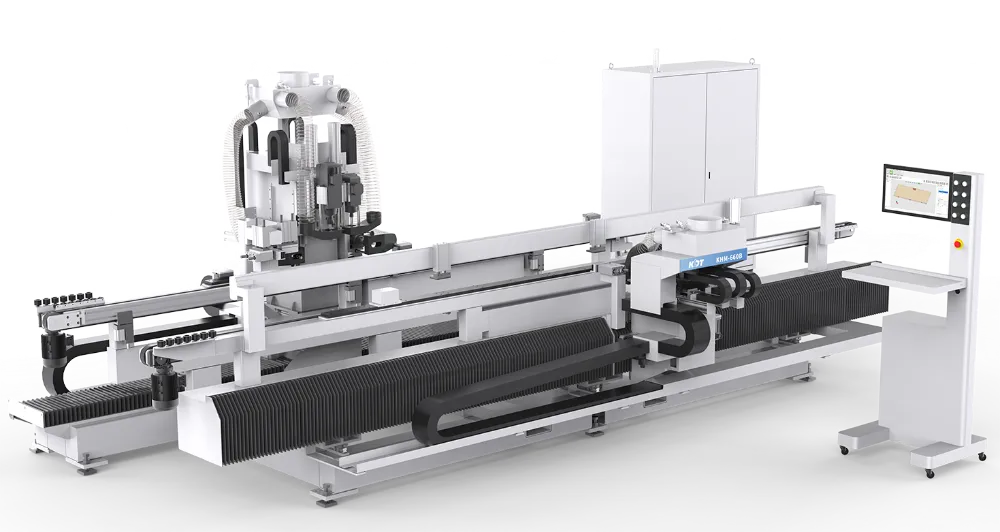
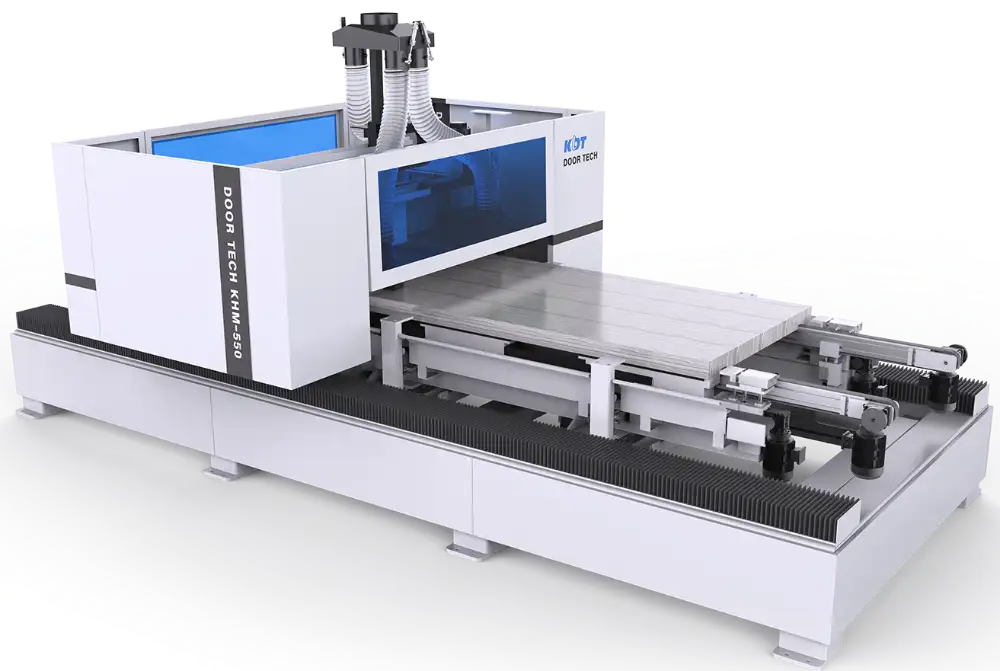
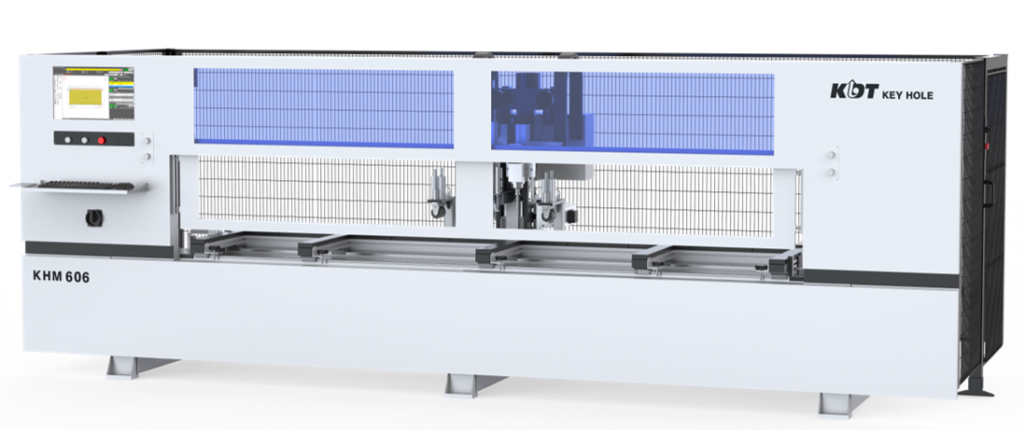
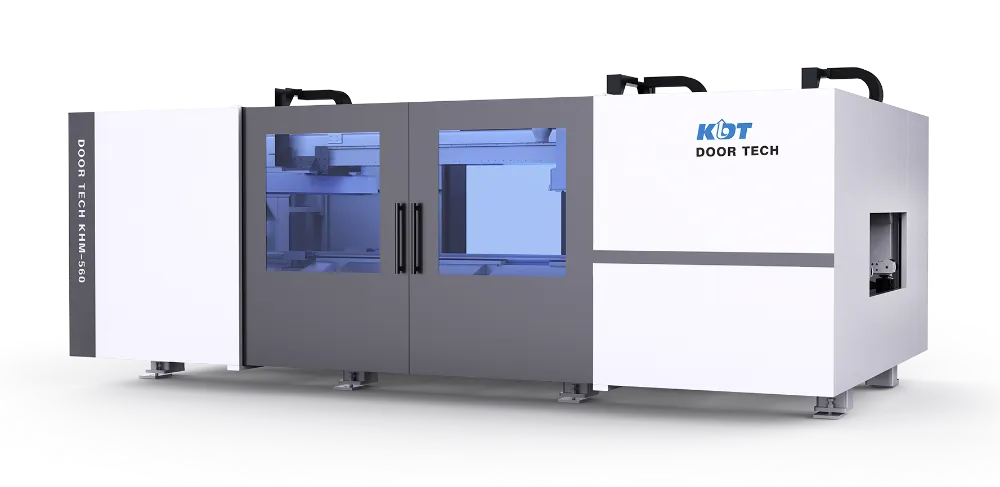
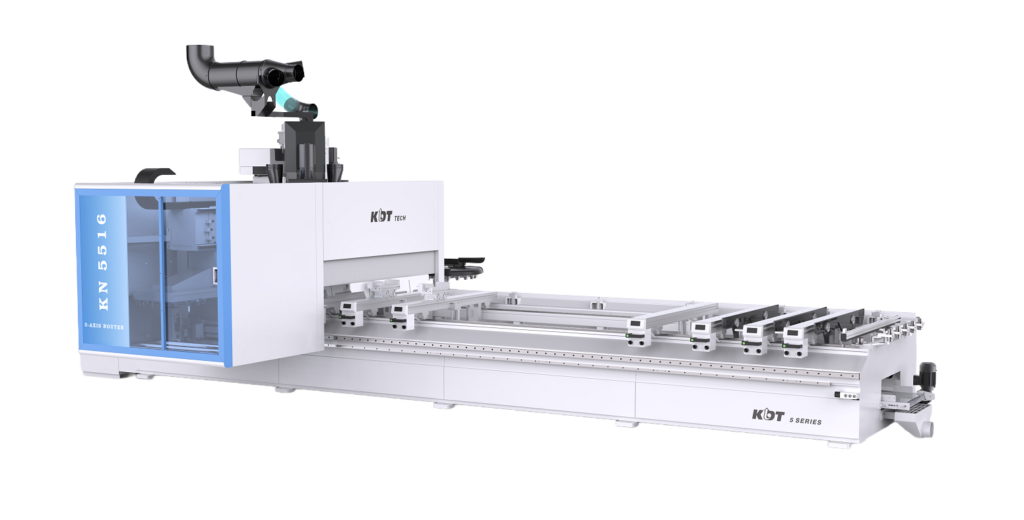
Door machining is one of the most demanding phases in industrial joinery manufacturing. Each door must leave the line with exact dimensions: milled rebates, drillings for hinges and locks in place, squared edges and surfaces calibrated within tolerance.
When that process fails, the problem isn't discovered at the machine, but on site. At KDT Ibérica we work with door manufacturers who cannot afford that margin of error, and that's why our machinery is designed to deliver precision and repeatability in every production shift.
What is door machining and what operations does it include?
Wood machining in doors comprises the set of mechanical operations that transform a panel or block of wood into a functional door and to the required dimensions.
This is not a single operation, but rather a sequence of tasks applied to the material at different stages of the production line.
The typical operations are:
- Squaring and dimensioning: cutting the door to size with perfectly square angles on all edges.
- Calibration: equalising the board thickness to guarantee consistent tolerances across the entire batch.
- Hinge and lock boring: multiple drillings that must be positioned with millimetre precision so that the hardware fits without subsequent adjustments.
- Rebate and groove routing: machining on the edge to accommodate weatherstrips, locking systems or sliding door guides.
- Frame machining: on some models the frame is also worked to guarantee exact correspondence with the leaf.
The materials worked with are, for the most part, solid wood, MDF, chipboard and cellular-core doors.
Each material requires different cutting parameters and feed speeds, something that KDT machines allow to be adjusted easily.
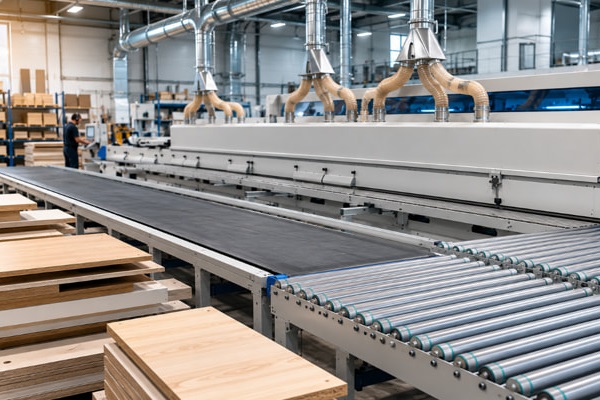
Machines for machining wooden doors: overview
There is no single machine that solves the entire process. The reality of an industrial joinery is that door machining requires several specialised machines working in a coordinated manner.
The types of machinery involved in the process are:
- Squaring machines, for initial cutting and dimensioning.
- Multi-spindle and industrial boring machines, for hinge and lock drillings.
- CNC boring machines with numerical control, for more complex and precise operations.
- Wide belt sanders for wood, for surface finishing and thickness control.
- 5-axis machining centres, for complex work in a single setup.
The choice of each machine depends on production volume, the variety of door models and the level of automation required.
At KDT Ibérica we help each customer to define which combination best suits their actual situation, and our showrooms in Spain, Portugal and Morocco allow you to see these machines working before making any decision.
Sliding table saws for doors: precision cutting and sizing
The sliding table saw is the first machine that intervenes in door machining. Its function is to give the panel the exact length and width dimensions, ensuring that all edges form 90-degree angles with the precision necessary for subsequent operations (boring, routing) to be carried out on a correct reference.
A poorly squared door carries the error through to all subsequent stages. That is why initial sizing is not a minor step: it is the foundation on which the rest of the process is built.
At KDT Ibérica we have sliding table saws designed for door production, with work tables of sufficient length to handle standard and large-format panels, programmable stop systems and controlled feed that guarantee repeatability in long runs.
The model KHM-560P is an example of a machine that combines squaring and machining on the same platform, reducing the number of material handling operations and cycle time per door.
Multi-spindle boring machine and multiple boring machine for doors
Boring is the most critical operation in door machining from a functional point of view.
The drillings for hinges, handles or locks must be exactly where the hardware requires them. A positioning error of just a few millimetres means the door must be reworked by hand or, in some cases, scrapped entirely.
An industrial multi-spindle boring machine carries out all the necessary drillings on the door in a single cycle, both on the face and on the edge, with perfect alignment between them. This is what sets a multi-spindle boring machine apart from a conventional boring machine: the ability to drill several points simultaneously or sequentially without repositioning the workpiece.
The main production advantages are:
- Reduced cycle time per door.
- Elimination of accumulated positioning errors from multiple clamping operations.
- Ability to work with standard or customised hardware templates.
- Greater consistency in long production runs.
At KDT Ibérica we offer industrial multi-spindle boring machines suitable for both medium-production workshops and high-volume installations.
Our models allow the spacing between spindles to be adjusted to suit different hardware standards without the need for costly replacement parts.
CNC boring machines and numerical control in door machining
When the variety of door models is high or machining operations include profiles, grooves and routing in addition to drilling, a CNC boring machine is the right tool.
Numerical control allows each operation to be programmed from software, reproduced accurately on every workpiece and switched between door models in seconds, without changing physical tooling or readjusting stops.
The practical difference compared to a conventional boring machine or even a fixed multi-spindle boring machine is flexibility: the CNC boring machine works with coordinates, not with templates. This means that to add a new door reference, you simply load a new programme, not modify the machine.
Other advantages of the CNC boring machine in door machining:
- Total repeatability in batches of any size, with no tolerance drift between the first workpiece and the last.
- Capability to perform complex operations (milling, pockets, grooves) in the same cycle as boring.
- Process traceability: each programme is recorded and can be audited.
- Reduction of human error to a minimum, as the machine follows the programme instructions without interpretation.
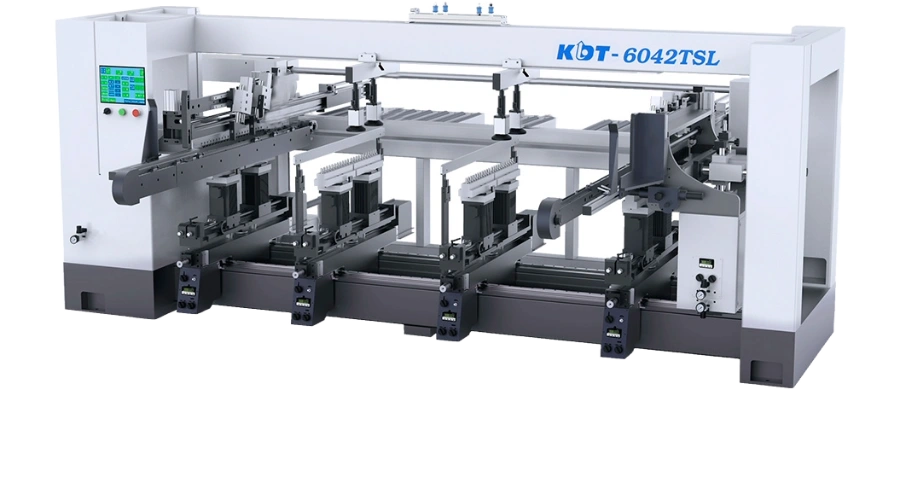
In our catalogue, the CNC wood drilling machines from KDT Ibérica are designed to integrate into both existing production lines and standalone work cells.
The programming interface is intuitive, which reduces operator training time and speeds up commissioning.
Solid wood wide belt sander: finishing and tolerances in doors
The solid wood wide belt sander acts on the thickness of the panel or machined leaf to homogenise it within the required tolerance margins.
In door machining, this operation has two main functions: to ensure that all doors in a batch have exactly the same thickness, and to prepare the surface for the final finish (lacquering, veneering or varnishing).
A poorly adjusted wide belt sander generates thickness variations that affect the behaviour of the hardware and the fit of the door in the frame. That is why calibration is not a cosmetic step, but a functional quality requirement.
The wide belt sanders we use at KDT Ibérica work with abrasive rollers of selectable grit and adjustable feed, which allows adaptation to different types of wood and different surface conditions of the material.
Their in-line integration with the rest of the machining equipment allows production flow to be maintained without bottlenecks.
Flexible door machining lines: from individual machines to automated production
A joinery workshop producing a small number of doors per day can work with standalone machines and operators moving workpieces between stations.
But when volume increases, that way of working becomes the biggest brake on productivity: transport and handling times between machines frequently exceed the actual machining time.
Flexible door machining lines solve that problem by integrating the different operations into an automatic sequence, where the workpiece advances from one station to the next without manual intervention.
The result is a drastic reduction in total cycle time and improved quality, because the workpiece is not repositioned or handled between operations.
Scalability is one of the aspects our customers value most: it is not necessary to start with a complete line. You can begin with two or three machines and expand the line when production volume justifies it, maintaining compatibility between equipment.
At KDT Ibérica we offer flexible door machining lines configured to measure according to door type, production rate and available floor space.
Before proposing any configuration, we analyse the customer's current process to identify where the bottlenecks are and which solution eliminates them most efficiently.
Door machining: CNC technology and precision for machining
Door machining has become an ally in the joinery and construction industry.
Traditional methods are a thing of the past, giving way to CNC (computer numerical control) technology, which enables work to be carried out with unique precision.At KDT Ibérica, we understand the importance of this transformation and we make available special machinery for the machining of doors.
This process not only optimises production times, but opens up a range of possibilities in terms of shape, finishes and design, adapting to the specific needs of each project.
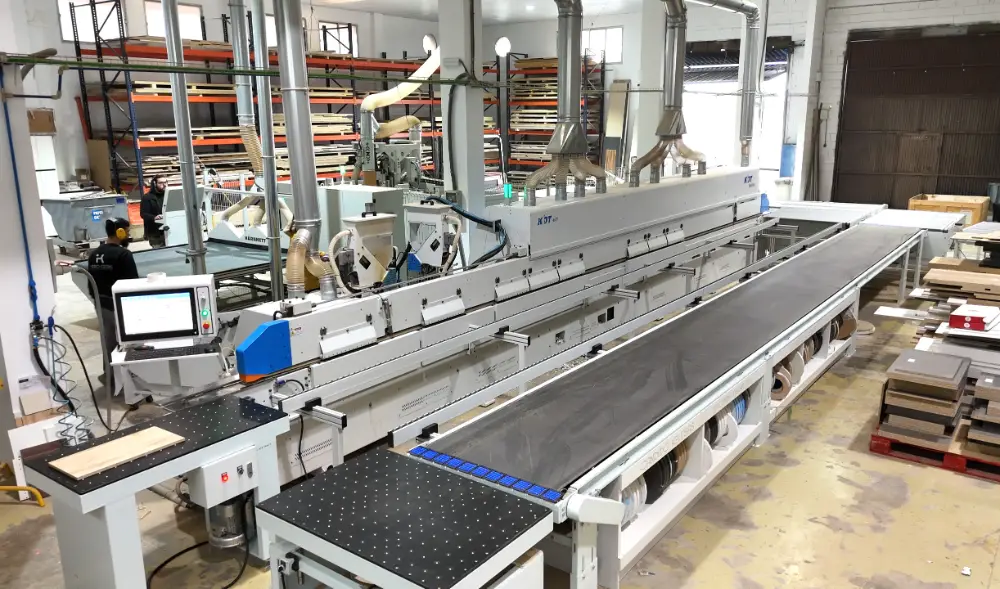
5 Advantages of industrial machining over traditional methods
The implementation of door machining centres in the industry has resulted in a significant improvement over traditional craft methods.
Among the main advantages are:
1. Greater precision and consistency
Numerical control technology makes it possible to achieve an accuracy that would be impossible by manual methods. This accuracy is important to ensure that elements such as locks and hinges function correctly throughout the life of the door.
2. Reduced production times
A machining centre can complete all necessary operations in a fraction of the time that manual work would require. This efficiency makes it possible to meet the demands of tight project deadlines.
3. Capability for complex designs
Designer door machining benefits from CNC technology, as it enables patterns and shapes to be created that would be extremely difficult or impossible to achieve manually.
4. Resource optimisation
Computerised systems calculate the most efficient way to perform each operation, minimising material and energy waste.
5. Production flexibility
A single machining centre can be quickly adapted to work with different door models, facilitating customisation without slowing down production.
The future of machining in the door industry
The door machining sector continues to evolve constantly, driven by technological advances and increasingly specific market demands. The combination of advanced CNC technology with professional expertise is raising the standard of quality and possibilities in the industry.
Machining centres for doors are becoming more versatile, integrating different operations in a single machine and thus reducing production times. Furthermore, the technology enables more efficient loading and unloading of materials when integrated into flexible production lines, optimising the entire production process.
For construction and design professionals, staying up to date on the possibilities offered by door machining is essential to harness its full potential in future projects. The precision, versatility and customisation capability that this technology provides will continue to be differentiating factors in an increasingly demanding market.
At KDT Ibérica we have our door machining machinery catalogue that adapts to each client's needs, from small workshops to large industries.
Our selection enables any type of work to be carried out with maximum quality and durability guarantee.
Why choose KDT Ibérica for your door machining machinery?
There are many suppliers of joinery machinery. The difference with KDT Ibérica lies not only in the catalogue, but in how we support the client from the moment they start evaluating a purchase until the machine has been in production for years.
Showrooms with machines in operation. We have facilities in Spain, Portugal and Morocco where you can see the machines working with real material before making a decision.
We're not talking about static demonstrations: the machine performs machining, the operator works and the customer evaluates the result with their own eyes. This eliminates doubts that no catalogue can resolve.
Adaptation to each process. We don't sell standard machines to all customers in the same way. We analyse the type of door each customer manufactures, their volume, their space and their current level of automation, and propose the configuration that makes sense for that specific case.
Specialised after-sales service. Our technical support service knows every machine we have installed. When there's an issue, the technician who takes the call knows which machine it is, what configuration it has and how to resolve it. Downtime is the biggest hidden cost in a production line, and reducing it is part of our job.
What you get with KDT Ibérica
- See the machines in real operation before purchasing
- Configuration adapted to your door type and volume
- Operator training included in commissioning
- After-sales service with technicians specialised in each machine
- Possibility to expand the line incrementally
What you avoid
- Buying a machine that doesn't fit your process
- Long stoppages due to lack of specialised technical support
- Oversized investments for current volume
- Excessive learning times due to lack of training
- Incompatibilities when wanting to expand the line later
Would you like more information and to know which configuration best suits your door production?
Request a quote or consult our catalogue and one of our technicians will analyse your case with no obligation.
Frequently asked questions about door machining
What is the difference between a CNC boring machine and a multi-spindle boring machine for doors?
The multi-spindle boring machine works with a fixed arrangement of heads that always performs the same drillings in the same positions. It is the most productive solution when manufacturing a limited number of references with standard fittings.
The CNC boring machine, on the other hand, uses programmed coordinates, which allows changing door models without modifying the machine. It is more flexible, although the cycle time per piece may be slightly longer in very long and uniform runs. The choice depends on the variety of the door catalogue and production volume.
What machine do I need if I'm starting to manufacture doors on an industrial scale?
It depends on volume and variety. For medium production with few references, a multi-spindle boring machine and a sliding table saw are a solid starting point.
If the variety of models is high, it is advisable to incorporate a numerically controlled boring machine from the outset.
If the volume justifies automation, an integrated flexible line significantly reduces the cost per door. At KDT Ibérica we can help you size the investment according to your actual production, without over-specifying.
Is it possible to integrate KDT machines into an existing production line?
In the vast majority of cases, yes. Our machines are designed to work both autonomously and integrated with other equipment.
Before any installation we analyse the client's current line to guarantee compatibility and define the best way to incorporate the new equipment without disrupting production more than necessary.
What maintenance does a door machining machine require?
Maintenance depends on the type of machine and the rate of use. In general, periodic inspections include verification of heads and cutting tools, lubrication of guides and spindles, and checking of numerical control parameters.
Our After-Sales & Technical Service offers preventive maintenance plans tailored to each piece of equipment, which reduces the likelihood of unplanned stoppages and extends the service life of the machinery.
 Spanish
 Portuguese
 English