
There's nothing more obvious on a piece of furniture than poor edge banding. You can have good cuts, good design and good material… but if the edge fails, the customer sees it instantly.
Peeling edges, excess glue, visible lines or a poor finish. And in production, that translates into lost time and products that don't make the grade.
That's why understanding how to choose an edge banding machine is key if you want to make a real leap in quality and efficiency, especially when you start working with volume or are looking for a more professional finish.
Why an edgebander is so important in your workshop
A An edge banding machine (or edge bander) is designed to apply edging to panels automatically, using hot-melt adhesive and controlled pressure systems.
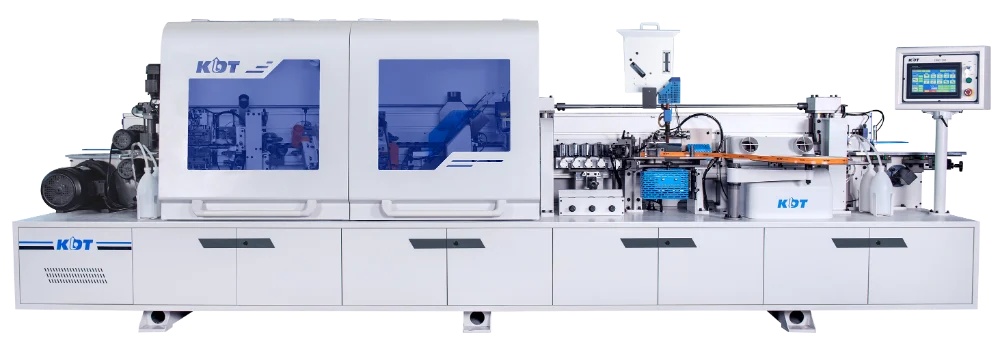
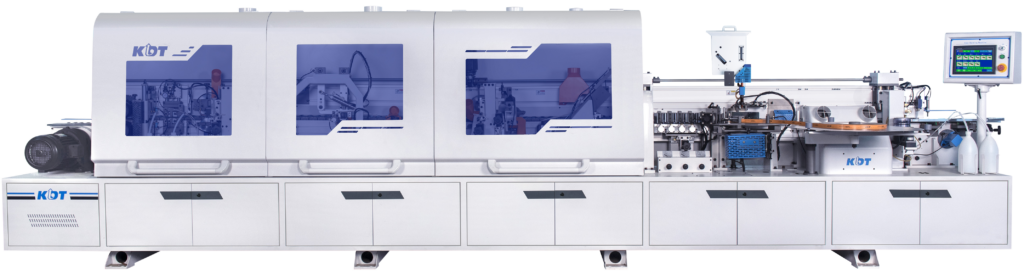
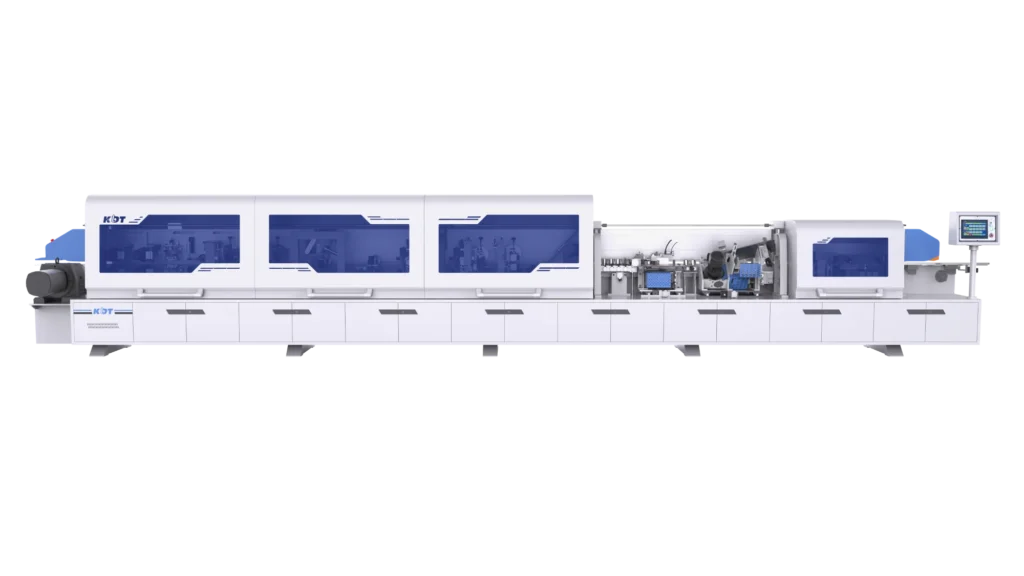
Its function is not just aesthetic. A good edge banding machine allows you to:
- Protect the boards
- Improve the durability of the furniture
- Guarantee a high-quality finish
- Ensure uniformity in production
In joinery and the furniture industry, it is one of the machines that most influences the final perception of the product.
In day-to-day operations, the edge banding machines are involved in practically all panel processing operations:
| Application of edges to panels From melamine to MDF, ensuring correct sealing. | Improved finish Avoids visible defects such as bubbles, excess glue or misalignment. | Increased production Allows large volumes to be processed without relying on manual processes. | Reduction of errors Thanks to automated pressure and temperature systems. |
Which edge banding machine should I choose?
Below we explain the different types of edge banding machines available.
Curve gluing machine
It is designed to work on pieces with irregular or rounded shapes, where a conventional edge banding machine cannot guarantee a good finish.
This type of machinery allows glue to be applied with precision and efficiency on curved edges, maintaining constant pressure throughout the process.
It is an ideal solution for manufacturers of bespoke furniture or products with complex designs, where finish and quality are key factors in making the difference.
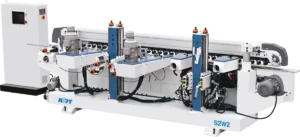
Double gluers
They are designed for high-production environments, as they allow working on two sides of the panel simultaneously. This improves production line efficiency and reduces processing times.
They are widely used in industry where optimising resources and reducing operational costs is required.
Thanks to their simultaneous working capacity, these edge banding machines are one of the best solutions for companies looking to increase their productivity without compromising precision or finish quality.
Single-side gluers
These are the most common within the sector and are characterised by working on one side of the panel per pass. They are versatile and adapt to different types of production, from professional workshops to larger factories.
This type of edge banding machine stands out for its balance between initial purchase price, performance and ease of maintenance. Furthermore, it allows working with different materials and types of adhesive, guaranteeing a uniform, high-quality finish on every piece.
What to consider when buying an edge banding machine
This is where you really need to make informed decisions.
1. Type of production
A craft workshop is not the same as an industrial production line. You must analyse:
- Work volume
- Type of product
- Production rate
This determines what type of edge banding machine you need.
2. Adhesive application system
The adhesive system is one of the most critical points. Look at:
- Type of adhesive
- Application uniformity
- Temperature control
A good glue reservoir guarantees uniform bonding and prevents long-term problems.
3. Pressure and precision
The pressure applied to the edge is key to the result. A high-quality machine must offer:
- Constant pressure
- Precise adjustments
- Adaptation to different materials
This allows for a clean and durable finish.
4. Types of materials and edges
Not all machines work equally well with all materials. You must consider:
- Type of board
- Type of edge (PVC, ABS, wood…)
- Thicknesses
Choosing a machine that meets your needs and adapts to different materials will give you more flexibility.
5. Final finish
This is where the difference really shows. A good edgebander allows:
- Removal of excess glue
- Clean edge cutting
- Final polishing
This avoids having to manually rework the workpieces.
6. Maintenance and ease of use
Daily maintenance directly influences efficiency. A good machine must:
- Have easy access to components
- Allow quick cleaning
- Reduce downtime
This helps reduce long-term costs.
7. Initial purchase price vs performance
Price is important, but it's not everything. A more economical machine can generate:
- More errors
- More maintenance
- Lower productivity
In the long term, choosing the best edge banding machine is usually the most cost-effective option.
Invest in quality and take the professional leap
Choosing the best edge banding machine is not an expense, it's a decision that directly impacts the quality of your products, the efficiency of your production andthe profitability of your business.
When you work with the right machine, you reduce errors, optimise times and achieve a finish that really makes the difference against the competition.
If you're looking to improve your workshop or take the leap to more professional production, now is the time to invest in high-quality machinery. At KDT Ibérica you'll find solutions tailored to every need, with technology designed for professionals who want real results.
Contact us now without obligation by completing our contact form.
Frequently asked questions about edge banding machines
Which edge banding machine should I choose?
It depends on your production. For small workshops, a single-sided machine is sufficient. For high production, it's advisable to choose the best automatic or high-end edge banding machine to improve efficiency.
Why is the glue tank important?
The glue tank influences the quality of the finish. It enables uniform application, improves processing and helps reduce costs.
Is a high-end edgebander recommended?
Yes, if you're looking for precision and efficiency. Although the initial purchase price is higher, it offers better performance and lower maintenance in the long term.
How do edge banding machines help reduce costs?
They reduce errors, optimise production and decrease glue consumption. This improves efficiency and profitability.
What maintenance does an edge banding machine need?
Daily maintenance includes cleaning, pressure checks and glue system monitoring. This ensures high quality and greater machinery durability.

 Spanish
 Portuguese
 English