Curved edge banding machine: KDT industrial models

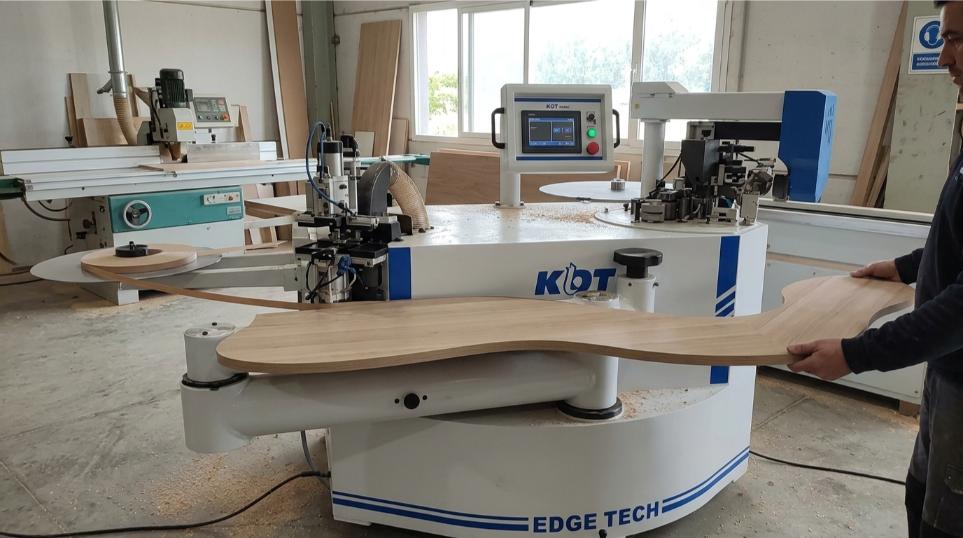
The difference between a conventional edge banding machine and a machine designed for curves lies in how it manages pressure and adhesive application on non-linear geometries. In a standard edgebander, the rollers and guides work in a straight line: the panel advances at constant speed and the adhesive is applied uniformly on a straight edge.
When the workpiece has curves, that system fails: the pressure is not distributed properly, the adhesive does not bond uniformly and the final finish shows detachment or bubbles.
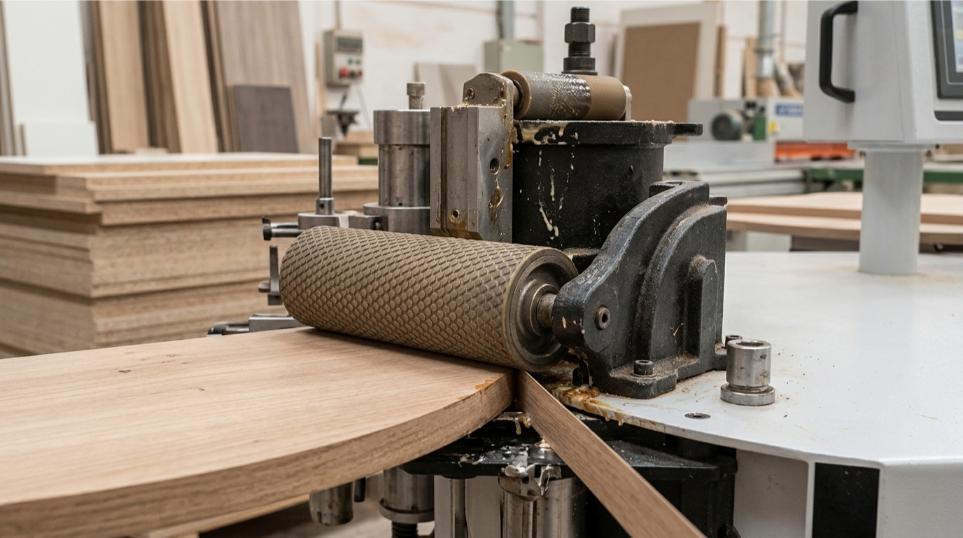
A curved edgebander solves this problem with a flexible pressure roller design, a glue pot adapted to maintain optimum temperature even with irregular feed rates, and a workpiece guide that allows the panel to be rotated during edge banding.
The result is an edge bonded with the same strength on the straight section and on the tightest curve.
The most common applications are:
- Furniture fronts with rounded corners
- Panels for designer tables with organic shapes
- Doors and panels with arches or free-form shapes
- Bathroom or kitchen furniture components with tight radii
- Contract furniture components where finish is critical
If you wish to explore the general selection criteria in more detail, consult our guide how to choose an edge banding machine.
Curve gluing machine
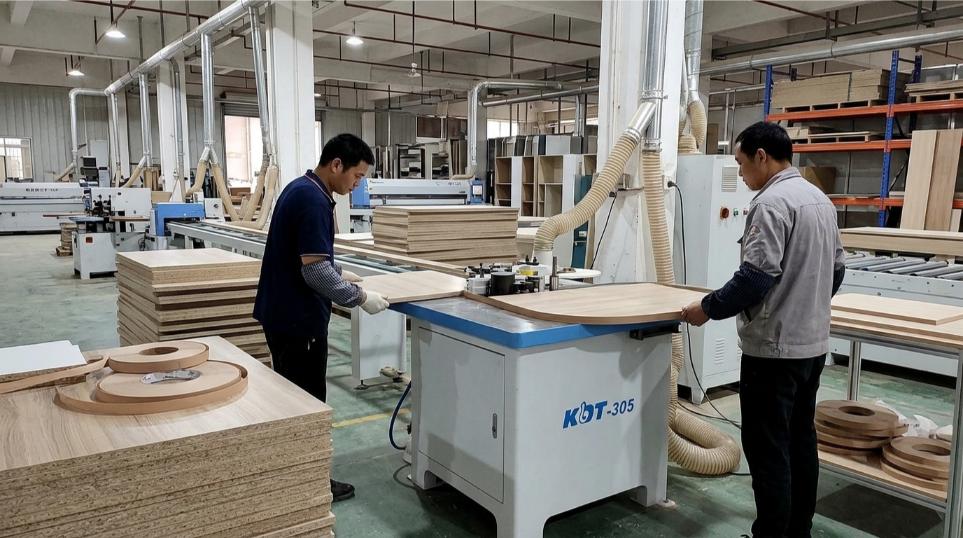
KDT-305 curve gluing machine
KDT-305MC Edge Banding Machine
The KDT-305MC is our advanced reference for curved edge banding in demanding production environments. It incorporates an adhesive application system compatible with both EVA and PUR adhesives, which extends the range of edge materials supported and improves bonding resistance under high humidity or temperature conditions.
Among its key technical features:
- Compatible adhesive: EVA and PUR, with independent glue pot to maintain optimum viscosity
- Pressure roller adaptable to variable radii, with adjustable pressure according to edge thickness
- Feed speed and power adjustable to suit the curve radius and material type
- Supported edge materials: ABS, PVC, wood veneer, melamine and solid wood edges
- Finish: prepared to work in a single pass with a result ready for the next process stage
The KDT-305MC model is the recommended option for factories with medium and high volumes, where edge banding repeatability and PUR adhesive compatibility make the difference compared to more basic solutions.
At KDT Ibérica we work with workshops, industrial joinery shops and furniture manufacturers that need to apply edge banding to curved workpieces without compromising quality or performance.
A curved edge banding machine is not a lesser version of a standard edgebander: it is a machine designed from the ground up to adapt to the contour of panels and workpieces without straight geometry, where the pressure roller, glue unit and feed system must work in coordination on surfaces that change angle at every centimetre.
If you manufacture tables, chairs, rounded kitchen fronts, curved doors or any furniture element with free-form shapes, this category is your starting point.
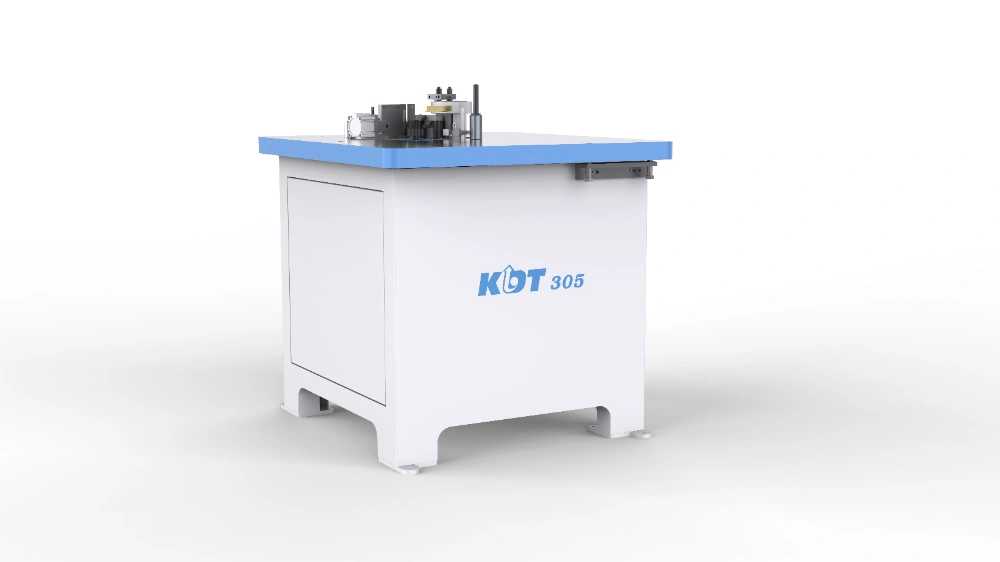
The KDT-305 is the base model in our curved edge banding machine range, designed for workshops and industrial joinery businesses that need to cover curved workpiece edge banding with reliability and a more competitive entry cost.
Main features:
- Compatible adhesive: EVA, with rapid-heating glue pot
- Pressure roller for curved workpieces with manual pressure adjustment
- Forward speed adapted to workpieces with medium and large radii
- Edge materials: ABS, PVC, wood veneer and melamine
- Robust structure prepared for continuous professional use
The KDT-305 is a solid entry point for workshops that until now carried out curved edge banding manually and want to make the leap to a machine that guarantees a homogeneous finish and significantly reduces time per workpiece.
To complete the finishing process for your workpieces, our edge sanding machine for wood is the natural complement to this machine.
Technical keys for choosing a curved edge banding machine
When a production manager evaluates an edge banding machine for curved workpieces, there are five parameters that determine whether the machine fits your process or not:
- Minimum curve radius accepted
Each machine has a minimum radius below which it cannot work reliably. Check that the model covers the tightest radii of your workpieces before making a decision.
- Adhesive type: EVA or PUR
EVA adhesive is the standard option: good performance, lower cost and simpler maintenance. PUR adhesive offers a bond more resistant to moisture and heat, and is the usual choice in kitchen, bathroom or contract furniture. If you have doubts about which adhesive you need, the type of end product gives you the answer.
- Forward speed
In curved edge banding, the feed speed must adapt to the radius of the workpiece. Too high a speed on tight curves causes irregularities in adhesive application and premature detachment. Look for models with adjustable feed speed.
- Adaptable pressure roller
The pressure roller is the element that guarantees the adhesion of the edge to the panel. On curved workpieces, a rigid roller does not distribute pressure well: you need a system with the capacity to adapt to the contour of the workpiece.
- Compatible edge materials
ABS, PVC, wood veneer, melamine or solid wood edging have different thicknesses and rigidities. Verify that the machine accepts the materials you use regularly before finalising the purchase.
Manual or automatic edge banding machine for curves: which do you need?
The answer depends on production volume and the level of finish that your process requires.
If your workshop edge bands curves occasionally and the radii are wide, a manual solution may be sufficient. When production is continuous, radii are tight or the finish is critical for the end customer, automation pays for itself quickly.
If you also produce straight pieces, see our range of single-sided edge banding machines for wood to cover both types of work with the most suitable machine in each case.
Manual edge banding machine for curved edges
- Suitable for workshops with low or irregular production
- Lower initial investment
- The operator guides the workpiece and controls the pressure
- Ideal when batches are short and radii vary
- The finish depends to a greater extent on the operator's skill
Automatic edge banding machine for curved edges
- Recommended for factories with medium or high production
- Greater repeatability and consistency in edge banding
- Automatic control of glue temperature and roller pressure
- Reduces time per piece and dependence on the operator
- Compatible with PUR glue in advanced models
Jointer vs edge banding machine: differences you should know
It is common for searches to mix the terms jointer for wood and edge banding machine. They are two different machines with complementary but different functions:
- A wood jointer is a cutting machine: its function is to flatten and straighten the edges and faces of solid wood boards, removing irregularities and leaving a smooth, square surface for subsequent work.
- An edge banding machine applies a decorative or protective edge(ABS, PVC, wood veneer, melamine) onto the edge of an already cut panel, bonding it with EVA hot-melt or PUR reactive adhesive.
In a furniture production line, the jointeroperates before edge banding when working with solid wood. The edge banding machine works on the already cut panel to protect and finish the edge. These are different processes that require specific machinery, and confusing them can lead to purchasing the wrong equipment.
If you are looking for woodworking machinery for a different use than curved edge banding, at KDT Ibérica we have a wide range of woodworking machines and joinery machines adapted to each phase of the production process.
We work with workshops and factories in Spain and Portugal that needwoodworking machinery with real technical support, not just an online catalogue. This is what sets us apart from a marketplace or a general distributor:
- Active showrooms where you can see the machines in operation before making a decision
- Customised adaptation of the equipment to the specific requirements of your production process
- Specialised After-Sales & Technical Service with technicians trained in the KDT range for installation, commissioning and maintenance
- Available stock of the main models and access to spare parts without excessive waiting times
- No-obligation quote tailored to your production volume and type of workpiece
Why choose KDT Ibérica for your curved edge banding machine
If you have any doubts about which model best suits your workshop, contact us. We analyse your case and propose the most suitable solution, with no shortcuts.
What is the minimum curve radius that KDT machines can handle?
It depends on the specific model. Contact our technical team with your workpiece dimensions and we'll confirm compatibility before purchase.
Can I use PUR adhesive on KDT curved models?
PUR adhesive is available on the KDT-305MC model. If your process requires high resistance to moisture or heat adhesion, this is the recommended model.
What edge formats do these machines accept?
KDT curved models work with ABS, PVC, wood veneer, melamine and solid wood edges in various thicknesses. Consult the technical data sheet for each model for exact ranges.
What maintenance does a curved edgebander require?
Basic maintenance includes cleaning the glue pot, checking the pressure roller and verifying the working temperature. With correct and regular maintenance, the machine's service life is significantly extended.
Do these machines also apply straight edges?
Yes. KDT curved models can work on both curved and straight edges, making them a versatile solution for workshops producing mixed-geometry workpieces.
Do you offer training for using the machines?
Yes. Commissioning includes operator training by our technicians. We also have after-sales support to resolve queries during normal use.
Want to know which model best suits your production? Request your personalised quote o browse the complete catalogue and we'll help you find the curved edge banding machine you need.
 Spanish
 Portuguese
 English